
I’ll never forget the first time I soared over the Kinglor Forest on my ikran—the mist clinging to every leaf, the distant glow of a Na’vi camp, and the overwhelming sense that I could fly for hours and still not see it all. That feeling made me wonder: just how big is Avatar: Frontiers of Pandora’s map compared to other Ubisoft heavyweights? And why does it feel so different to get around? After dozens of hours across its three regions, I’ve got a few thoughts.
Let’s start with raw numbers. The map here follows the classic Ubisoft open-world formula—one massive landmass, fog of war that peels back as you uncover locations, and total freedom to go anywhere. Its structure immediately reminded me of Far Cry 6, where you hop between distinct territories on the island of Yara. But there’s a twist: Pandora isn’t an island; it’s just a slice of a continent, and that changes everything.
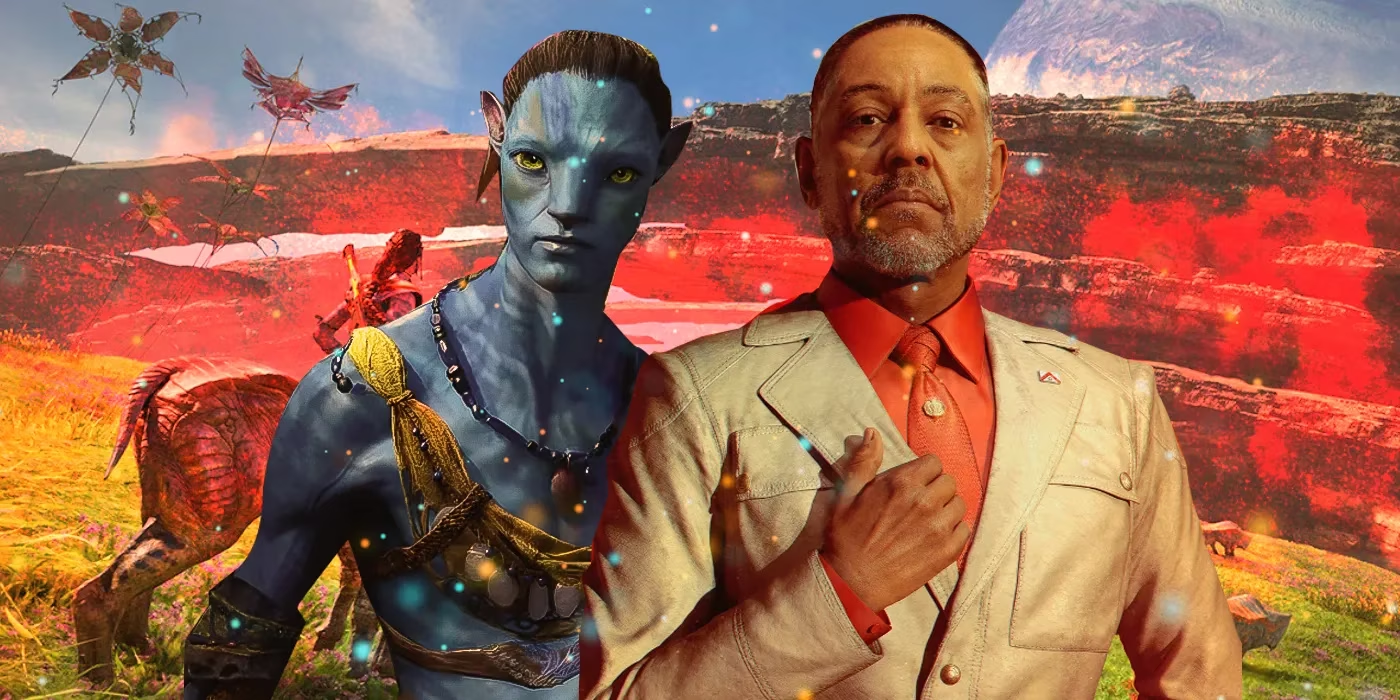
I spent way too long staring at side-by-side map shots, and honestly, the scales are tricky to nail down. Far Cry 6’s Yara is split into four main chunks—Esperanza, Madrugada, Valle del Oro, and El Este—plus a couple of smaller islands. Overall, that world clocks in at roughly 34 square miles (88 square kilometers). Avatar: Frontiers of Pandora, by contrast, gives me just three core regions: the Clouded Forest, Kinglor Forest, and Upper Plains. Comparing the two, it’s pretty clear Pandora’s map is a tad smaller. If I assume each region is roughly equal—and they’re not, but bear with me—we’re looking at about 25.5 square miles (66 square kilometers). Numbers on a page, sure, but when you’re down on the ground, it’s a whole different beast.
Why did Pandora feel bigger than those stats suggest? Two reasons: verticality and density. In Far Cry 6, I’d hop in a car and tear down a road, ticking off waypoints. In Pandora, I’m climbing colossal trees, squeezing through glowing caves, and circling floating mountains that hide entire biomes above the clouds. The map isn’t just a flat surface—it’s a layered maze. I remember thinking, “I’m sure this ridge was only a few hundred meters away,” but then I’d get sidetracked by a rare plant or a banshee nest, and suddenly an hour had vanished. The game doesn’t just ask you to travel; it dares you to get lost.
And speaking of getting lost, that brings me to the map modes. Before I jumped in, I didn’t realize how much of an impact these settings would have. Ubisoft gives you two choices: Guided mode and Exploration mode. I started with Guided because, well, old habits die hard. It’s your typical modern RPG approach—color-coded pins, neat quest markers, and a compass that stays mostly empty unless you set a custom waypoint. Hunter’s Sense lets you pulse the environment to see nearby objectives without opening the map. If you just want to breeze through the story or hate second-guessing directions, it’s a cozy safety net.
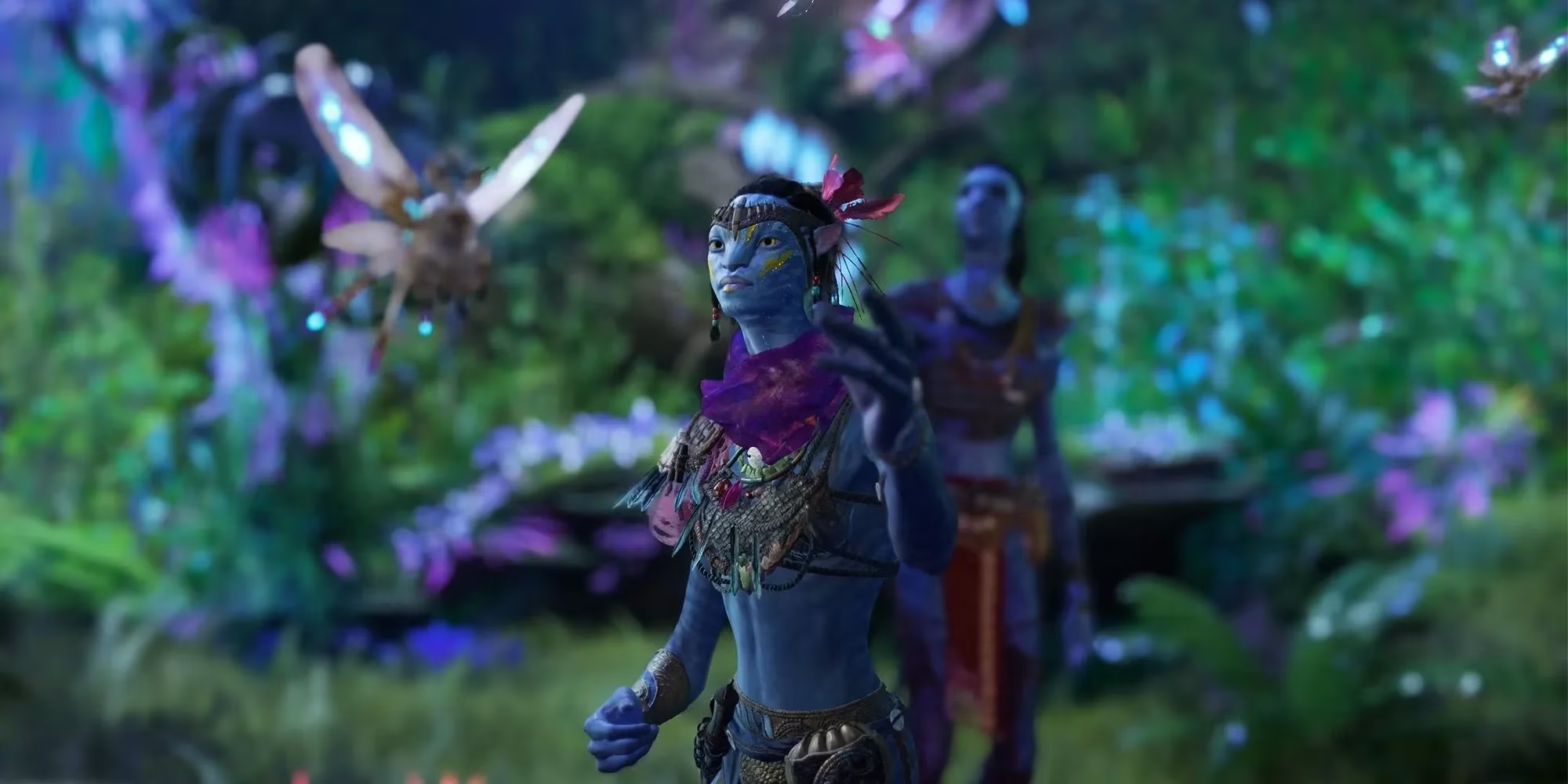
Then I switched to Exploration mode, and let me tell you, it was like taking off a pair of noise-canceling headphones I didn’t know I was wearing. Suddenly, no quest waypoints. No glowing trail. Just a few vague notes like “find the Na’vi camp in Gossamer Lakes.” I’d pull up the map, see the region labeled, but after that? I was on my own. I had to read the land—look for smoke trails, follow the sound of distant drums, or watch for paths beaten by wildlife. It threw me back to the days of old-school RPGs where your brain was the compass. I’ve got to hand it to the devs: this mode makes Pandora feel twice as large because you’re not just moving from A to B; you’re genuinely exploring.
Of course, Guidance mode is still there if I ever get frustrated, and that’s the beauty of the system—you can flip the switch mid-game. But I stuck with Exploration, and honestly, it turned routine fetch quests into mini adventures. One time, I spent twenty minutes circling the Upper Plains looking for a camp that turned out to be hidden under a waterfall. Did I feel a bit silly? Sure. But I also noticed the way the light filtered through the canopy, the herd of sturmbeest in the distance, and a hidden cave I would have missed otherwise. That’s the magic.
So, how does it all stack up? Avatar: Frontiers of Pandora’s map might not snag the “biggest Ubisoft map” crown—that still belongs to Assassin’s Creed: Valhalla, which feels endless in its own right. Yet Pandora holds its own by making every square kilometer count. When I’m in Exploration mode, relying on my senses and letting curiosity guide me, this world feels absolutely enormous. It’s a reminder that size isn’t just about square mileage; it’s about how a space invites you to live in it. And live in Pandora I did, for nights on end, never quite sure if I’d seen it all—and that’s exactly how an Avatar game should feel.
Comments