
For over two decades, Ubisoft's Far Cry franchise has not just dominated the open-world FPS genre—it has utterly conquered it, leaving a trail of imitators and shattered expectations in its wake! Since its explosive debut in 2004, the series has become a titan of the industry, a name synonymous with chaotic freedom, unforgettable villains, and sprawling, sun-drenched landscapes teeming with danger. Yet, beneath this veneer of explosive success lies a mystery so profound, so deliberately tangled, that it has fueled endless nights of fan debate and wild theorizing. The central enigma? The true, definitive connection between the sun-scorched insanity of Far Cry 3 and the revolutionary fervor of Far Cry 6. Is there a single, coherent timeline, or are we navigating a multiverse of madness?
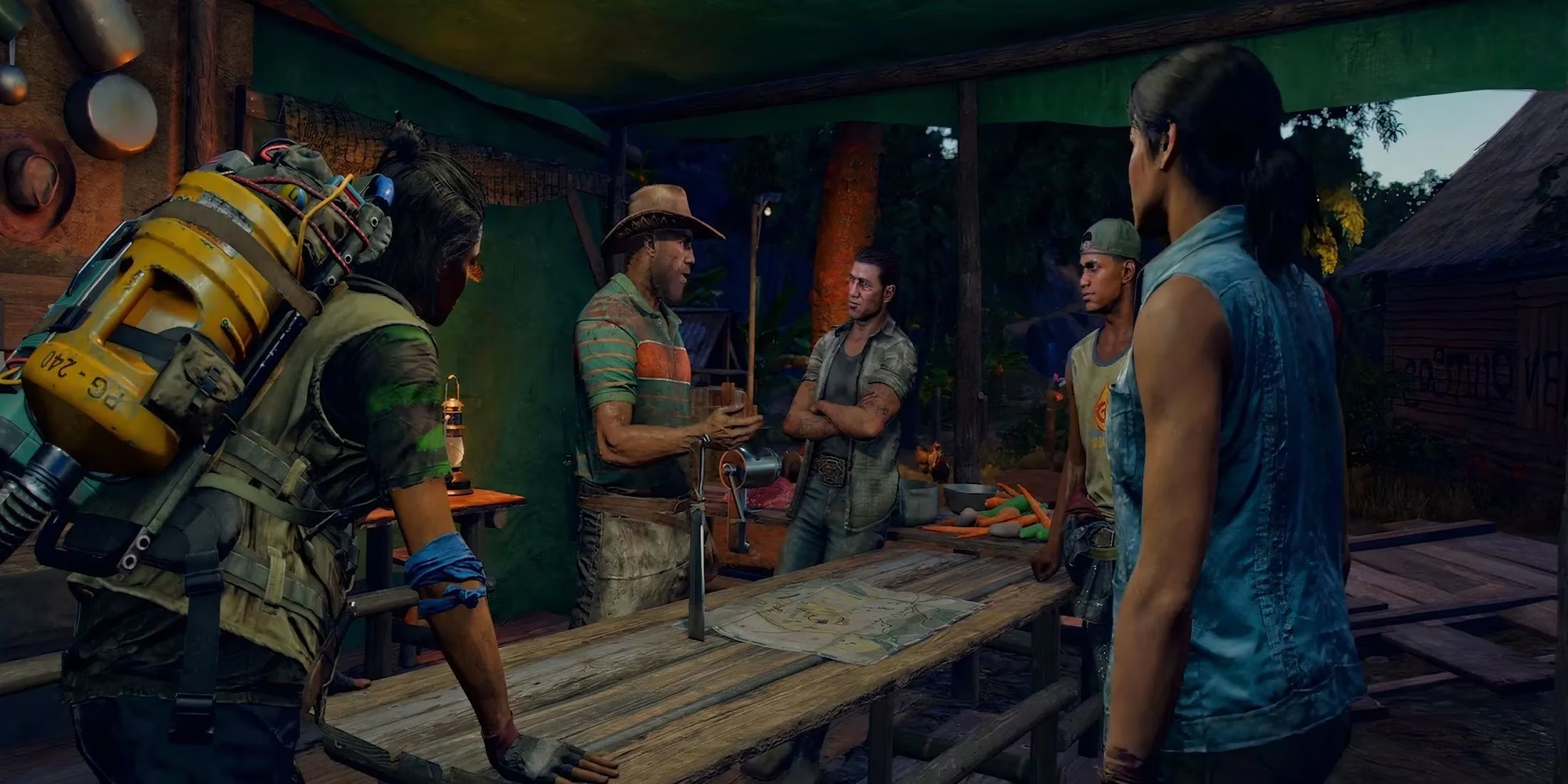
On the surface, the chronology seems laughably simple. Each game is a child of its time, a snapshot of the year it was released. Far Cry 3 is frozen in the amber of 2012, a tale of paradise lost and sanity shattered on the Rook Islands. Far Cry 6, with its in-game documents like Dani Rojas' driver's license, is firmly planted in 2021, a battle for the soul of Yara. Case closed, right? WRONG. The moment you dig even an inch below this tidy surface, the ground gives way to a labyrinth of contradictions and deliberate obfuscation. The franchise's timeline isn't a straight line—it's a Jackson Pollock painting of narrative possibilities.
The plot thickened monumentally in 2021 when Far Cry 6's narrative director, Navid Khavari, dropped a bombshell during a Reddit AMA. He declared the game's story to be "entirely separate" from the events of Far Cry 5. This wasn't just a statement about one game; it was a seismic shift in understanding the entire series. Khavari's words implied a retroactive truth: perhaps every Far Cry title exists in its own self-contained bubble, its own pocket universe. The myriad Easter eggs, the cheeky cameos? Mere winks to the audience, delightful fan service that builds a feeling of kinship without forging chains of hard canon. This official stance suggests Ubisoft plays faster and looser with continuity than a pirate with a map to buried treasure.
But then... the post-credits scene of Far Cry 6 happened. In a shadowy conversation, guerrilla mentor Juan Cortez speaks to an unseen smuggler. The voice that answers is unmistakable, a gravelly, hypnotic rasp that sent shivers down the spines of longtime fans. It was the voice of Michael Mando, the legendary actor who brought Far Cry 3's iconic psychopath, Vaas Montenegro, to terrifying life. This single audio cue ignited a firestorm of questions that still rages in 2026.
The Core Paradox:
-
Vaas was, by all accounts, definitively killed by Jason Brody in Far Cry 3 (2012).
-
Far Cry 6 is set in 2021.
-
Yet, his voice is heard, clear as day, nine years later.
How is this possible? The fan theories exploded like a well-placed C4 charge:
🔥 Theory A: The Survivalist – Vaas never died. He survived his wounds, vanished into the criminal underworld, and resurfaced as a smuggler, his madness tempered (or evolved) by time.
🌀 Theory B: The Multiverse – Each Far Cry game exists in a separate, parallel reality. The Vaas we hear is a variant from another timeline, a concept that has only grown in popularity across media since 2021. This allows for familiar faces and concepts to reappear without breaking any single world's rules.
🎭 Theory C: The Meta-Nod – It's purely an Easter egg, a loving tribute with no narrative weight. Michael Mando voiced a character, but it's not the Vaas, just a clever reuse of a beloved actor's talent.
The implications of the Multiverse theory (Theory B) are particularly staggering for the franchise's future. It grants Ubisoft ultimate creative freedom:
| Advantage for Ubisoft | Consequence for the Timeline |
|---|---|
| Unlimited Cameos | Characters like Hurk Drubman can appear anywhere, anytime, without explanation. |
| No Continuity Lock | Stories are never constrained by past events. Every game is a fresh start. |
| Fan Service Galore | They can reference any past game without being obligated to follow its lore strictly. |
| Creative Flexibility | Settings, tones, and tech levels can vary wildly between entries. |
This approach, while liberating, creates a fascinating narrative philosophy. The Far Cry series isn't building a single, cohesive history like a fantasy epic. Instead, it's weaving a tapestry of thematic echoes—stories about ordinary people thrust into extreme violence, confronting charismatic tyrants, and the blurred lines between liberation and chaos. The connections are emotional and thematic, not strictly chronological.
So, where does this leave the burning question of Far Cry 6 and Far Cry 3? The answer, as of 2026, remains gloriously, frustratingly ambiguous. The developers have provided the clues—the separate timelines statement, the Vaas voice cameo—but have refused to connect the dots for us. This isn't incompetence; it's a masterstroke. By not committing, they have:
-
Kept the debate alive and the community engaged for years.
-
Protected all future narrative possibilities.
-
Elevated the series' lore from a simple timeline to a playground for interpretation.
The door is flung wide open. Perhaps a future game will finally bridge these worlds, revealing a secret history that connects Vaas's insanity to the revolution in Yara. Or perhaps it never will, and the mystery will remain part of the franchise's enduring legend. One thing is certain: in the chaotic, unpredictable world of Far Cry, the only sure bet is that nothing is ever as simple as it seems. The timeline is a suggestion, canon is a flexible concept, and the voice of a dead villain on a smuggler's radio is a reminder that in this franchise, the past is never truly buried—it's just waiting in another reality, ready to resurface when you least expect it. 😉
Comments