
The gaming community is abuzz with anticipation for Ubisoft's next major installment in its long-running open-world series. As of 2026, while an official announcement remains elusive, persistent and credible leaks have painted a picture of a potentially revolutionary entry. Far Cry 7, known internally as Project Blackbird and reportedly developed by Ubisoft Montreal, is rumored to be taking a bold, non-linear approach to its narrative and gameplay. The most prominent and discussed leak, originating from Insider Gaming in late 2025, suggests a core premise where players must rescue kidnapped family members in any order they choose, all under the immense pressure of a strict 72-hour in-game time limit. This single, controversial mechanic could fundamentally reshape the entire Far Cry experience, potentially forcing the removal of one of the franchise's most beloved and integral features: its diverse array of vehicles.
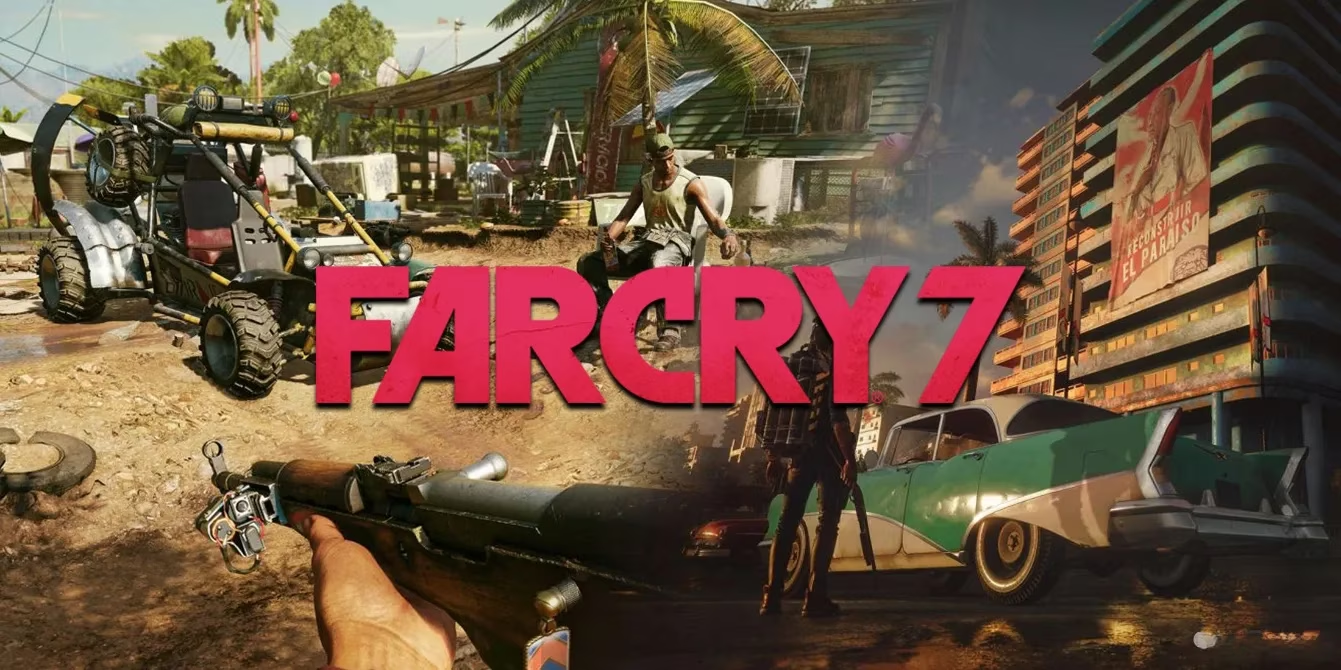
Could a time limit truly work in a sprawling open-world game like Far Cry? 🤔 On one hand, this mechanic represents a daring experiment to inject a new sense of urgency and intensity into a formula that, while beloved, has faced criticism for becoming somewhat predictable over the years. Imagine a scenario where every firefight, every failed stealth attempt, and every inefficient path costs you precious minutes towards saving your family. This pressure could forge the most tense and memorable campaign in the series' history, transforming side activities from leisurely distractions into high-stakes gambles for resources or information. The freedom of choice remains, but each choice would carry a tangible, immediate consequence, a stark departure from the more relaxed pace of past titles.
However, this carefully constructed tension would completely unravel if players retained the same level of vehicular freedom seen in Far Cry 5 or Far Cry 6. In those games, players are never far from a car, ATV, helicopter, or even a wingsuit. A time limit becomes almost meaningless if you can simply hop into a helicopter and zip across the map in minutes to your next objective. This presents Ubisoft with a significant design dilemma: how do you maintain the punishing, impactful nature of a countdown while providing the player with the tools to traverse a vast world?
The Vehicle Conundrum: A Necessary Sacrifice?
The logical solution, as hinted by the leaks, might be the most drastic one: a severe restriction or even the complete removal of player-controlled vehicles from Far Cry 7. Over the last decade, vehicles have become synonymous with the franchise's identity, perfectly complementing its expansive maps. Removing them would be a seismic shift. But would it be a step forward or a step back?
Let's consider the alternatives Ubisoft might have explored:
| Design Option | Potential Benefit | Major Risk |
|---|---|---|
| Slower Vehicles | Maintains traversal options while preserving time pressure. | Risks making vehicles feel cumbersome and unfun to use. 🐌 |
| Restricted Vehicle Types (e.g., no air vehicles) | Reduces fast-travel capability, increases ground-level tension. | Feels like a regression from previous games' freedom. |
| Complete Removal | Forces immersive, tactical traversal; maximizes time-limit impact. | Eliminates a core, enjoyable part of the sandbox experience. 😱 |
If the developers choose the "nuclear option," the pressure on the remaining gameplay pillars would be immense. The removal of such a beloved feature would only be justified if other systems were dramatically enhanced to fill the void.
Building a World Worth Exploring on Foot
Without vehicles, how would Far Cry 7 keep players engaged? The answer lies in a profound evolution of its core mechanics. The game world would need to be designed not for fast travel, but for meaningful, dangerous, and rewarding exploration on foot. This could lead to several key improvements:
-
Enhanced Survival & Crafting: 🪓 The series' survival-lite elements would need to deepen significantly. Crafting wouldn't just be for syringes and molotovs; it could be essential for creating temporary shelters, purifying water, or setting traps for both wildlife and human enemies. Scavenging for resources would become a critical, time-sensitive activity.
-
Revolutionary Gunplay & Stealth: Every bullet would count more than ever. Gunplay would need to feel weightier and more tactical, perhaps with a greater emphasis on weapon condition and scarce ammunition. Stealth systems would need refinement, making silent takedowns and avoiding conflict a more viable and time-efficient strategy compared to all-out assaults.
-
Dynamic World & Verticality: The map itself would need to tell stories. Dense, layered environments with increased verticality—think treacherous mountain passes, complex cave systems, and dense, multi-level urban ruins—would make traversal an engaging puzzle rather than a chore. Dynamic weather and day/night cycles could have a more pronounced effect on visibility and enemy behavior.
-
Strategic Fast-Travel Alternatives: While personal vehicles might be gone, the game could introduce risky, player-activated fast-travel methods. For example, hijacking an enemy convoy for a one-way ride, or using unstable zip-lines and gondolas that could break or be ambushed. These methods would carry risk, aligning with the time-limit's high-stakes philosophy.
Ultimately, the rumored design of Far Cry 7 poses a fascinating question about modern open-world design. Is the ultimate freedom of effortless traversal at odds with creating genuine narrative tension and challenge? By potentially removing vehicles and imposing a strict clock, Ubisoft Montreal seems poised to test that very hypothesis. The success of such a bold move would hinge entirely on their ability to craft a world so compelling, and gameplay so refined, that players won't miss the roar of an engine—because every second of their frantic, on-foot journey to save their family feels more impactful than any joyride ever could. Only time (and an official reveal) will tell if this gamble pays off, potentially redefining what a Far Cry game can be in 2026 and beyond.
Comments