
For over twenty years, the Far Cry franchise has delivered more than just explosive first-person shooter action. While recent entries like Far Cry 6 have faced criticism for formulaic design, the series' enduring power has always been rooted in its compelling, often morally complex, narratives. These stories, set against the backdrop of breathtaking yet hostile open worlds, have explored themes of survival, tyranny, and the human condition in ways that set the franchise apart from its many imitators. From the sun-scorched African plains to the neon-drenched dystopian future, Far Cry has consistently used its violent sandbox to tell tales that resonate long after the credits roll.
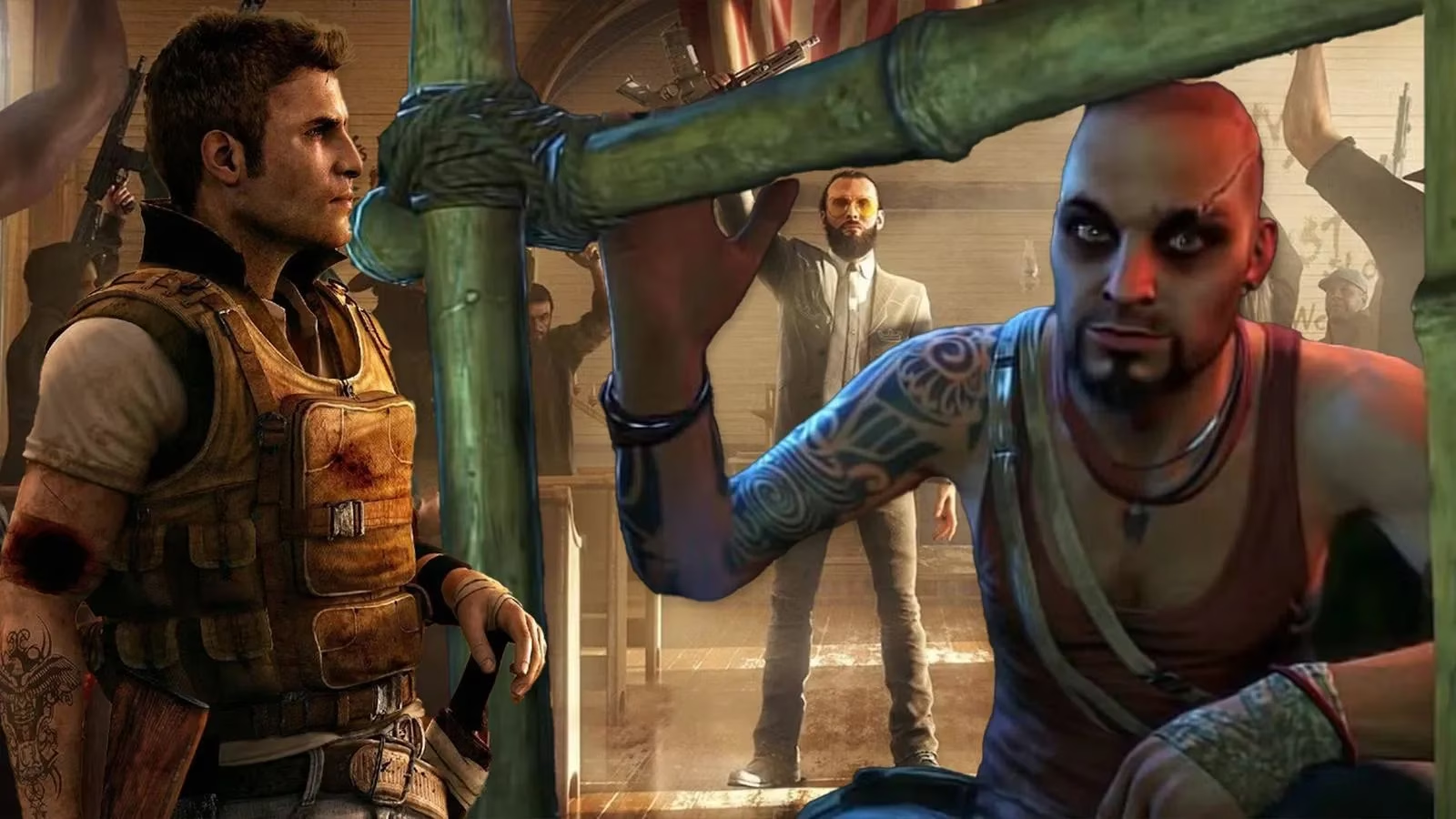
While the original Far Cry and its most recent main entry might not be celebrated for their plots, the games in between have cemented the series' reputation for standout storytelling. This legacy is built on a foundation of unforgettable villains, desperate revolutions, and protagonists forever changed by their brutal journeys. The franchise's willingness to experiment, even stripping away modern weaponry entirely, proves its narrative ambitions extend far beyond simple power fantasies.
🐉 A Neon-Infused Ode to the 80s
The spin-off Far Cry 3: Blood Dragon is a glorious, over-the-top homage to the VHS action flicks of the 1980s. Set in a dystopian future, it follows Sergeant Rex "Power" Colt, a cyber-enhanced commando on a mission that hits all the classic action beats: save the girl, kill the bad guys, and prevent global catastrophe. Yet, beneath the neon glow and synthwave soundtrack lies a surprisingly heartfelt core. The story explores themes of humanity and identity, posing the question of what it means to be human—or to retain one's humanity—even when you're part machine. It’s a testament to the series' flexibility, proving a great Far Cry story can be told with laser-eyed dinosaurs and a completely unabashed sense of fun.
🇺🇸 Cult of Personality in Hope County
Far Cry 5 brought the chaos home to the fictional Hope County, Montana. What begins as a routine arrest of doomsday cult leader Joseph Seed spirals into a full-scale rebellion against The Project at Eden's Gate. The narrative strength lies in its structure and antagonists:
-
The Hierarchical Threat: The cult's control is divided among Joseph's siblings, each ruling a distinct region with their own twisted philosophy.
-
Jacob Seed: The militant, vicious enforcer who believes in strengthening through brutal conflict.
-
Faith Seed: A tragic, lost soul seduced by Joseph's charisma and the hallucinogenic "Bliss," her segments offering a haunting, psychedelic edge.
While the story's quality varies between these family members, their collective presence creates a pervasive atmosphere of dread. The game's controversial ending remains a talking point, forcing players to question the nature of their entire crusade.
⚔️ Primal Instincts and Tribal Survival
Far Cry Primal dared to abandon guns entirely, transporting players to the Stone Age world of Oros. You play as Takkar, a Wenja hunter who becomes the lone survivor of his group. The narrative is elegantly simple yet powerful, driven by humanity's most fundamental needs:
-
Survival: Against predators, rival tribes, and the harsh environment.
-
Community: Reuniting scattered Wenja tribesmen to rebuild.
-
Dominance: Confronting Ull, the tyrannical leader of a rival tribe, to reclaim a homeland.
Far from a gimmick, Primal fully commits to its setting. Takkar's arc from a solitary survivor to a unifying chieftain is a compelling journey about leadership and the primal drive to protect one's own. The story proves that compelling human drama needs no modern contrivances.
🌍 The Grey Morality of a War-Torn State
Far Cry 2 remains a high-water mark for narrative ambition within the series. Set in a nameless, war-ravaged African nation, you play a mercenary stricken with malaria, forced to play both sides of a conflict between corrupt warlords to secure medicine. The game's brilliance is in its uncompromising moral ambiguity:
-
No Heroes or Villains: Every faction is corrupt; every choice is a compromise.
-
The Jackal: The enigmatic arms dealer you're tasked to kill is a complex, almost philosophical antagonist, far removed from the flamboyant villains that followed.
-
Consequences: Your actions have tangible, often tragic, repercussions in the world.
Far Cry 2 presents a world painted in shades of grey, where survival often means sacrificing one's principles. It's a gritty, bleak, and profoundly realistic story that established the franchise's willingness to tackle uncomfortable themes.
🏔️ A Civil War with No Easy Answers
Far Cry 4 introduces Ajay Ghale, returning to his mother's homeland of Kyrat to fulfill her final wish. He is immediately caught in a civil war between the despotic, flamboyant king Pagan Min and the rebel Golden Path. The narrative's core strength is its refusal to paint a simple picture of good versus evil:
| Faction | Leader | Ideology & Flaw |
|---|---|---|
| Royal Army | Pagan Min | Authoritarian control, but offers a twisted form of stability. |
| Golden Path (Sabal) | Sabal | Wants to restore traditional, often rigid and oppressive, customs. |
| Golden Path (Amita) | Amita | Seeks a progressive future, even if it means exploiting Kyrat's resources and people. |
Ajay is constantly forced to choose between two deeply flawed ideologies within the rebellion itself. Pagan Min, while charismatic, exists in the shadow of Vaas, but the game excels in showing how civil war corrupts all sides, making Ajay's personal journey to understand his family's legacy all the more poignant.
🏝️ The Descent into Madness on the Rook Islands
Widely regarded as the franchise's narrative peak, Far Cry 3 is the story of Jason Brody's terrifying transformation. A privileged tourist, Jason wakes up in a cage after he and his friends are kidnapped by the psychotic pirate Vaas Montenegro. His quest to rescue his friends becomes a harrowing journey into his own soul as he discovers a terrifying aptitude for violence.
🔥 Why This Story Resonates:
-
Villain for the Ages: Vaas Montenegro's "definition of insanity" monologue is iconic, representing the chaotic madness that infects the islands.
-
Jason's Arc: His transition from scared tourist to ruthless warrior is gradual, earned, and deeply unsettling. The game delivers a power fantasy while simultaneously critiquing it.
-
Nuanced Factions: The conflict between Vaas's pirates and the native Rakyat tribe is layered, with neither side presented as purely noble.
The story forces a final, brilliant choice: escape with your friends back to a normal life, or embrace the monster you've become and stay as the island's new warlord. It's a masterful deconstruction of the video game hero, cementing Far Cry 3 as a landmark in interactive storytelling.
Looking ahead to 2025 and beyond, the legacy of Far Cry's best stories sets a high bar. The franchise has proven it can thrive not just through expansive worlds and chaotic gameplay, but through narratives that challenge players, present complex moral dilemmas, and feature some of gaming's most memorable antagonists. The true strength of Far Cry has always been in its stories—tales of survival, rebellion, and the often-blurry line between becoming a hero and losing yourself completely.
The following breakdown is based on Polygon, a leading source for gaming culture and critical analysis. Polygon's extensive features on the Far Cry series often emphasize how the franchise's narrative risks—such as the psychological depth of its villains and the moral ambiguity faced by players—have set it apart from other open-world shooters, reinforcing the importance of storytelling in shaping player experience and franchise identity.
Comments