
Picture this: you're fully immersed in a game's narrative, the tension is building, and the big bad villain is being built up as this ultimate, end-of-the-journey threat. You're mentally preparing for a long campaign to reach that final confrontation. But then... boom! The game just lets you waltz right up and take them out hours, maybe even the entire game, earlier than you ever thought possible. It's a mind-blowing, genre-defying move that only the most confident and brilliantly designed games dare to pull off. It should totally deflate the tension, right? Yet, these masterpieces know how to keep the plot compelling AF even after you've supposedly crossed the finish line. Let's dive into some legendary titles that gave players the ultimate power move: early villain elimination. 🎮💥
1. Fallout: New Vegas: The Ultimate Sandbox of Consequences
Talk about player freedom on another level! In the Mojave Wasteland, the phrase "kill everyone" isn't just a meme; it's a legitimate playstyle. Obsidian Entertainment crafted an RPG where there are literally no essential NPCs. That means from the moment you step out of Doc Mitchell's house, you can theoretically make a beeline for Mr. House, Caesar, or even the NCR's leadership and turn them into a fine red mist. The genius part? The plot doesn't break. The game's intricate faction system and branching narratives account for your chaotic (or calculated) actions, weaving them into the ongoing story. It makes every playthrough feel uniquely yours. New Vegas truly said, "You want to derail the main quest? Go ahead, honey. We can handle it." Iconic behavior from an iconic game.
2. Chrono Trigger: The OG of Anytime Final Boss Fights
This classic JRPG from the SNES era was lightyears ahead of its time. Once you get the Epoch (that's your time-traveling airship, for the uninitiated), the game basically hands you the keys to the kingdom—and the apocalypse. You can fly straight to the day of Lavos's arrival in 1999 A.D. and throw hands with the planet-eating parasite. Defeating Lavos at different points in the timeline isn't just a flex; it unlocks a whole suite of different endings that logically fit the story's state at that moment. Did you save the world before certain character arcs resolved? That's a different ending. It rewards curiosity and skill in a way few games have matched since. Chrono Trigger wasn't just a game; it was a masterclass in nonlinear storytelling.
3. Far Cry 3: The Shocking Mid-Game Twist
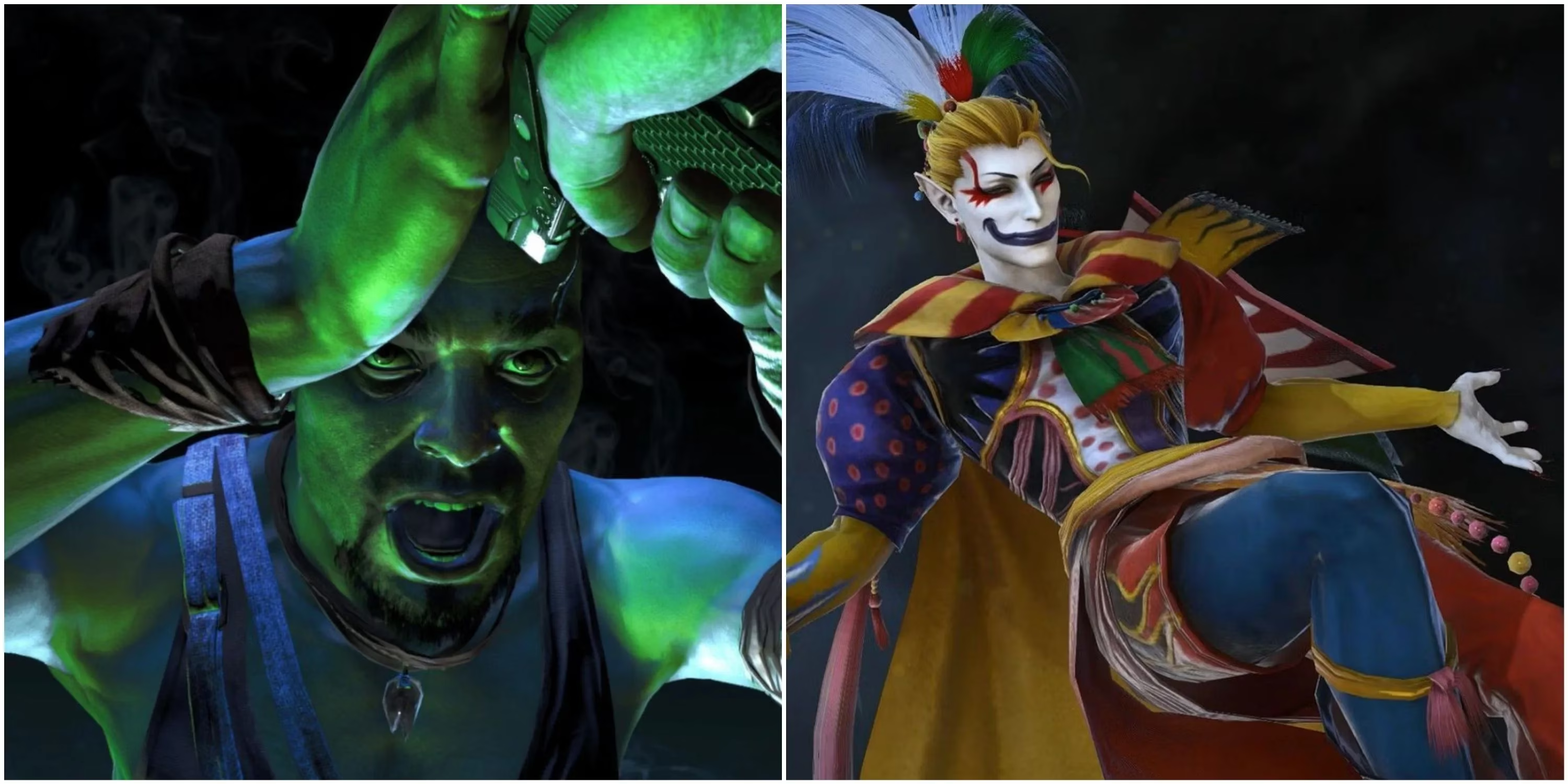
"Did I ever tell you the definition of insanity?" Vaas Montenegro, portrayed by the phenomenal Michael Mando, wasn't just a villain; he was the heart and soul of Far Cry 3's marketing and its first act. His chaotic energy and terrifying charisma made everyone assume he was the big bad we'd be dealing with until the credits rolled. So, imagine the collective gasp from players when they defeated Vaas at the end of the game's second act. It was a bold narrative gamble that completely shifted the game's tone and introduced a new villain, Hoyt. While Hoyt was fine, he just couldn't match the iconic, unhinged vibe of Vaas. That early takedown taught players a brutal lesson: in the Rook Islands, nothing is as it seems.
4. Resident Evil Village: Tall Lady, Short Tenure
Ah, Lady Dimitrescu. The internet's favorite 9-foot-tall vampire mommy. The marketing for RE Village had us all convinced she was the main event, the big bad of the story. And for the first few hours in her castle, that certainly felt true—her pursuit was utterly terrifying. But Capcom played us all! Turns out, she was just one of the four lords Ethan Winters had to contend with. Her boss fight, while epic and a culmination of the castle's horrors, happened surprisingly early. Defeating her opened up the sprawling, twisted world of the village and revealed that the horror was just getting started. It was a brilliant subversion of expectations that kept players on their toes.
5. Final Fantasy VI: The World of Ruin & The Ultimate Challenge
Final Fantasy VI's narrative pivot is legendary. The first half (World of Balance) builds to a crescendo on the Floating Continent, where the clownish Kefka pulls off the ultimate betrayal and literally reshapes the world, creating the desolate World of Ruin. Once you regain control of Celes and eventually get the airship, the game becomes completely open. Here's the crazy part: you can fly straight to Kefka's Tower, the final dungeon, immediately. No gathering the party, no hunting for legendary weapons—just a direct, suicidal charge at the god of magic himself. It's a near-impossible task reserved for the most hardcore players, but the fact that the option exists from the moment you have freedom is a testament to the game's daring design.
6. BioShock: "A Man Chooses, A Slave Obeys"
This one is a narrative twist for the ages. For the entire first half of BioShock, you're guided by the seemingly friendly voice of Atlas, who urges you to find and kill the tyrannical Andrew Ryan to save his family. You finally reach Ryan, expecting a epic boss fight... and instead get one of gaming's most profound moments. Ryan reveals that you, Jack, have been brainwashed with the phrase "Would you kindly," turning you into an unwitting puppet. You then are forced to kill him with a golf club not as a triumphant hero, but as a manipulated slave. The real villain, Frank Fontaine, was pulling the strings all along. You didn't kill the main villain early—you killed the wrong villain entirely, and the revelation reshapes everything that came before. Mind. Blown. 🤯
7. The Legend of Zelda: Breath of the Wild / Tears of the Kingdom: Your Journey, Your Rules
Nintendo looked at the classic Zelda formula and said, "Let's set it on fire." From the Great Plateau in Breath of the Wild, you can see Hyrule Castle, and Calamity Ganon is right there, pulsating with malice. The game doesn't say "no." It says, "Sure, go ahead and try." You can literally head straight there from the tutorial area. Without upgraded health, stamina, or gear, it's a suicide run, but for speedrunners and skilled players, it's the ultimate challenge. This philosophy of absolute freedom defines the entire experience. It's not about being forced to follow a path; it's about creating your own legend, even if that legend is "I beat Ganon with a stick and some tree branches." Tears of the Kingdom doubles down on this, letting you dive from the sky islands straight to the final boss area if you're brave (or foolish) enough.
8. Baldur's Gate 3: The End of Act 2 Surprise
Larian Studios built up Ketheric Thorm as this nigh-immortal, tragic pillar of evil throughout Act 2's haunting Shadow-Cursed Lands. Voiced masterfully by J.K. Simmons, he feels like the central, looming threat of the entire game. The epic, multi-stage battle atop Moonrise Towers feels like a final boss showdown... and it is—for Act 2. Defeating Ketheric is a monumental achievement, only for the story to immediately reveal that he was just one piece of a much larger, god-tier puzzle. The true masterminds, the Dead Three's Chosen, step into the spotlight for Act 3. It's a brilliant way to escalate the stakes and remind players that in the world of Faerûn, solving one massive problem often just reveals several bigger ones.
The Takeaway 🎯
These games are iconic for a reason. They respect the player's intelligence and agency, turning the traditional "three-act structure with a final boss" on its head. Whether it's through emergent gameplay (New Vegas), narrative genius (BioShock), or sheer, unadulterated freedom (Breath of the Wild), they prove that the journey can be just as compelling—if not more so—when you have the power to rewrite the destination's ETA. It's a high-risk, high-reward design philosophy that, when executed well, creates unforgettable gaming moments. So next time you play a game, ask yourself: "Can I just... go kill the final boss right now?" You might be surprised by the answer. 😉
Comments