
I've been playing Ubisoft games for what feels like forever. I mean, who hasn't spent hours scaling towers in Assassin's Creed or causing chaos in Far Cry? These worlds are like my second home. But lately, I've been having some... complicated feelings. It's like watching an old friend try out a bunch of new, flashy hobbies—some are brilliant, and others just make you scratch your head and wonder what they were thinking. The thing is, for every feature that pulls me deeper into their worlds, there's another that pushes me right back out. Let me walk you through my rollercoaster ride with some of Ubisoft's most talked-about mechanics.
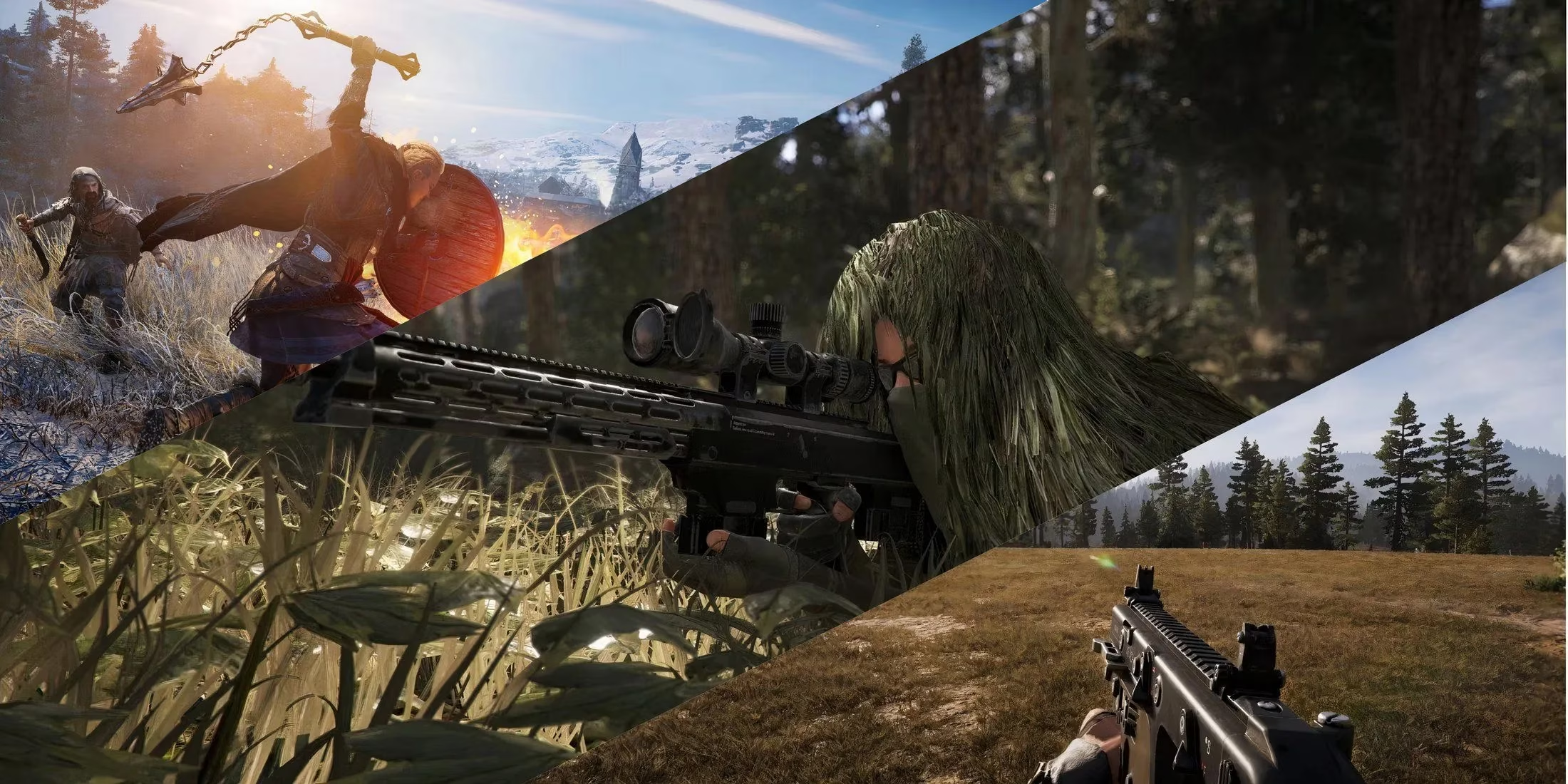
The Injury System: Realism or Just a Minor Inconvenience?
Let's start with Ghost Recon Breakpoint. When I first heard about the injury system, I was pumped. Finally, a tactical shooter where getting shot actually matters! The idea of limping to cover, bandaging a wound while under fire—it sounded intense and immersive. And honestly, when it works, it's fantastic. It makes you think twice before charging into a firefight. You start planning, using the terrain... it feels real.
But here's the kicker: the execution kinda fell flat. Finding health kits became as easy as finding rocks on the ground, and my backpack? Well, let's just say it had a magical, bottomless pocket for them. A critical leg wound that should have me crawling for extraction? Poof! Gone with a single medkit. It was a step in the right direction, but it ended up feeling more like a slightly annoying speed bump than a core survival challenge. A great idea that needed a bit more... guts, you know?
Building a Home in Ravensthorpe: A House or Just a Pretty Shell?
Then there's Assassin's Creed Valhalla. As Eivor, building Ravensthorpe from a muddy camp to a thriving settlement was supposed to be my legacy. It was this cool idea—Vikings weren't just raiders; they were settlers, builders. The customization options were wild! I could build a barracks, a tattoo parlor, a feast hall... it looked the part.
But after the initial excitement wore off... what was it, really? Ravensthorpe often felt like the prettiest house on a street full of nearly identical houses. Beyond looking cool and giving me a place to swap gear, it didn't do much. The features lacked a real mechanical punch. It was a hub, sure, but one that never quite felt like home. It changed the series, showed ambition, but left me wondering what could have been if those buildings had more impact on my saga.
The Level Grind: Customization or a Pace-Killer?
Oh, the leveling system. This one's a doozy. Assassin's Creed Origins brought it in, and it changed everything. Suddenly, my hidden blade couldn't one-hit-kill a higher-level guard. On one hand, I loved it! It gave me a new way to customize Bayek. Finding better gear, watching numbers go up—it was satisfying in that classic RPG way.
On the other hand... good grief, did it slow things down. I'd get a quest to investigate something urgent, only to find the area was guarded by enemies ten levels above me. Cue the grinding. And the loot! My inventory would be bursting with fifteen different "Common Sword of the Jackal" items, each with a 1% better stat boost. Building my loadout became less about crafting a stealthy assassin or a brutal warrior and more about playing spreadsheet simulator to find the highest crit chance. The fanbase is still split on this, and honestly, so am I. It adds depth but at the cost of the series' once-fluid pacing.
Bullet Sponges in Paradise: Far Cry's Identity Crisis
Far Cry 6 gave us Yara, a stunning, vibrant playground. But exploring it came with a strange new rulebook. The series has been flirting with RPG elements for a while, and here they went all in. Now, enemies have levels. That sleek new rifle? It might as well be a pea-shooter against a "boss" enemy in a starting zone.
Some players dig the kit-building it encourages. But for me? It creates a weird disconnect. I remember the older games where a well-placed headshot from a rusty pistol was all it took. It rewarded skill and smart play. Now, sometimes it feels like it rewards time spent grinding more than tactical thinking. Seeing a regular soldier absorb a whole magazine to the face just feels... off. It's a far cry from the series' roots, and not everyone is onboard for the trip.
A City of Heroes, A Story of No One
Finally, Watch Dogs Legion. This was the boldest swing. No main character. Instead, I could recruit anyone in London—the old lady walking her dog, the city banker, the street performer. The sheer scope is mind-blowing. One mission I'm a sneaky hacker, the next I'm a bare-knuckle fighter. The procedural stories that emerged were often hilarious and unique.
But...
And it's a big but.
Without a central hero to follow, the main story lost its heart. I had all these operatives, these tools, but no emotional anchor. The grand narrative about fighting authoritarianism felt thin because my character never grew, never changed. They were just a face and a set of skills. The revolutionary tale became oddly impersonal. It was a novel mechanic that offered incredible freedom, yet somehow made the world feel emptier.
So, where does that leave me? Still playing, that's for sure. Ubisoft's worlds are too compelling to leave behind. These polarizing features show a company that's willing to experiment, to push its iconic series in new directions. Sometimes it works, sometimes it doesn't. For every misstep, there's a spark of genius. They keep me engaged, even when I'm frustrated, because I'm always curious about what they'll try next. Will they refine these ideas? Or will the next game bring a whole new set of debates? Only time will tell, but the journey—with all its ups and downs—is never boring.
Comments