
As I stare at the neon-drenched skyline of Night City from my apartment window, the year is 2026, and the ghost of Los Santos still lingers in the digital ether. Twelve long years have passed since I first stepped onto the sun-baked streets of Los Santos in Grand Theft Auto V. The single-player narrative, a masterpiece of satire and chaos, became a benchmark, a sacred memory. Yet, the roaring success of its online sibling, GTA Online, cast a long shadow, leaving a profound yearning for that singular, authored criminal odyssey. The wait for GTA 6 became a pilgrimage, and in its vast, silent interim, I embarked on a quest—not to find clones, but to discover the kindred spirits and bold reimaginings that could sate my thirst for virtual anarchy, power, and poignant, chaotic stories.
The Roguelike Heist and the B-Movie Dream
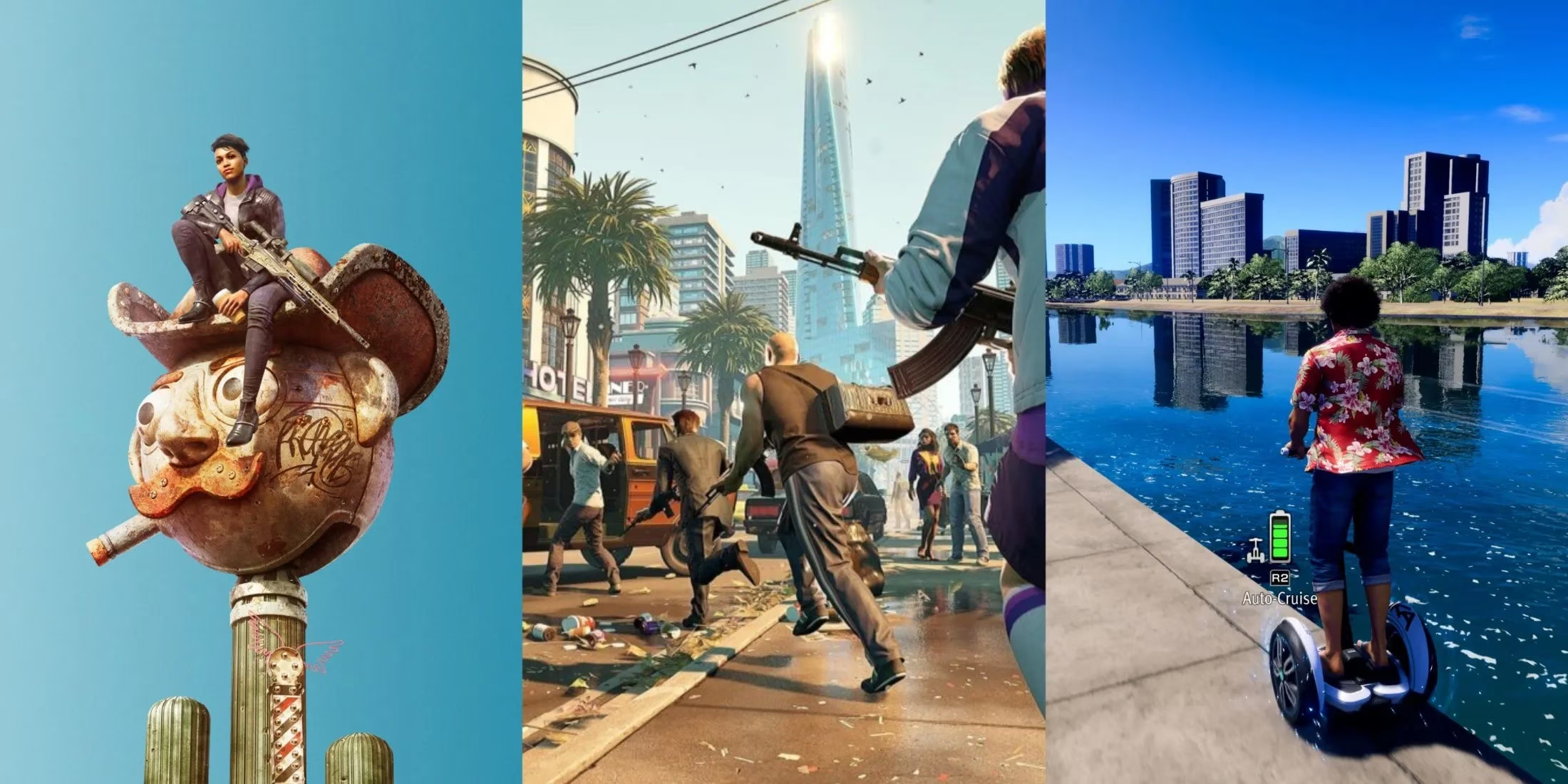
My journey first led me to the sun-bleached, 90s-inspired sprawl of Crime Boss: Rockay City. It promised a distilled essence of the GTA V heist fantasy, wrapped in a roguelike's cyclical embrace. The premise sang to me: build an empire, run heists, face consequences, and try again, wiser, with minor perks clinging to my digital soul. The casting was a glorious, pulpy spectacle—Michael Madsen's gravelly menace, Chuck Norris's untouchable aura. It felt like stepping into a direct-to-VHS gangster epic. Yet, the veneer cracked. The star power, a dazzling constellation, seemed to have consumed the soul of the game. Missions devolved into monotonous shootouts against waves of adversaries, the planning phase a ghost of what it could have been. I found a strange, affectionate tolerance for it—a so-bad-it's-good charm for a specific, nostalgic mood. It was a carnival ride, not a dynasty, but sometimes a cheap, chaotic thrill is its own reward.
The Chaotic Sibling: A Return to Roots
Then, I revisited an old, frenzied friend: Saints Row. This series, born in the shadow of its inspiration, had long since carved its own path of absurdity. The 2026 reboot was a homecoming of sorts, a return to turf wars and a sandbox begging for unruliness. It lacked the narrative depth and sharp social commentary of its muse, but it compensated with a torrent of pure, unadulterated bedlam. The customization was a playground, allowing me to craft an avatar of sublime ridiculousness. Driving a hoverbike shaped like a toilet through a neon-drenched city while wielding a giant tentacle weapon? That was its language. It felt like the chaotic, less-polished sibling who shows up uninvited to the party and somehow makes it more memorable. It was a reminder that the crime power fantasy can also be a canvas for sheer, joyful madness.
The Symphony of Coordinated Chaos
For a taste of precision and teamwork, I turned to the series that owns the multiplayer heist crown: Payday. Payday 3, by 2026, stands as a testament to redemption. Its launch was marred, a familiar tale of connectivity woes and bugs that rightfully drew ire. Yet, like a phoenix, it rose through relentless post-launch support. Today, it is a tightly wound simulator of orchestrated larceny. Donning masks with friends, coordinating every silent step before the alarms blare, then fighting through a storm of law enforcement—it captures a different facet of the thrill. It's less about personal narrative and more about the shared, pounding adrenaline of a plan coming together, or gloriously falling apart. The market it cornered remains uniquely its own.
Revolutions and Moral Shades
Craving a narrative with weight and moral complexity, I found myself on the tropical, war-torn shores of Yara in Far Cry 6. While stepping away from urban crime, it embraced the grand, open-world power struggle. As Dani Rojas, fighting to liberate a nation from a dictator, the game offered that same blend of compelling story and chaotic sandbox gameplay. Giancarlo Esposito's villainous turn as Antón Castillo provided a magnetic, chilling center. The game asked difficult questions about freedom, sacrifice, and the cost of revolution, echoing the moral ambiguity that often simmers beneath the surface of the best GTA tales. It was a different uniform, but a familiar fight for control in a beautifully hostile world.
The Hacker's Playground and a Living City
Ubisoft's Watch Dogs: Legion presented perhaps the most ambitious structural twist. Its vision of a near-future London, where every single person could be recruited into my hacktivist collective, was staggering. The hacking mechanics added a cerebral layer to the open-world formula, turning the entire city into a weaponizable circuit board. Driving through a rain-slicked digital rendition of London, I was oddly reminded of the niche classic Grand Theft Auto: London 1969. It captured that feeling of owning a city, not through brute force alone, but through information and networked rebellion. The world felt alive, not just as a backdrop, but as the very fabric of the resistance.
The Cerebral, Destructive Puzzle
In a stunning left turn, I discovered Teardown. This indie gem bore no mechanical resemblance to GTA, yet it honed in on one sacred pillar: the heist. It transformed planning from a menu selection into a physics-based art form. Each map was a fully destructible diorama. I would spend peaceful, unlimited time scheming—knocking down walls, creating ramps, lining up vehicles—crafting a perfect 60-second path of carnage and theft. The moment the alarm sounded, it was a heart-pounding sprint against physics and time. It was heist design reduced to its purest, most imaginative form, proving that the thrill of the perfect score transcends genre.
The Redemption of a Cybernetic Dream
And then, there was Cyberpunk 2077. By 2026, its story is one of legendary redemption. It launched into infamy, a cautionary tale of hype and broken promises. Yet, through years of unwavering support, Night City has been reborn into the dense, narrative-rich megalopolis it was always meant to be. As V, navigating the corporate-dominated hellscape, I found the spiritual successor to that GTA single-player craving. It offered a vast, vertical open world teeming with stories, deep character progression, and an overarching narrative of mortality and identity that gripped me with raw force. The dark, glittering streets became my new home, a place where every alley held a secret and every choice carried weight. It stands not as a substitute, but as a peer—a towering achievement in open-world storytelling.
The Heart of the Dragon
Finally, my odyssey led me to the streets of Yokohama and Honolulu in Like a Dragon: Infinite Wealth. The Yakuza/Like a Dragon series began as a brawler-inspired alternative but has blossomed into a genre-defying masterpiece. This latest entry is the culmination. It offers a rich, intimate open world packed with soulful side stories, an emotionally charged and wonderfully convoluted narrative, and a perfect blend of heartfelt drama and sublime wackiness. The transition to a turn-based RPG in Like a Dragon was a risk that paid off in spades, and Infinite Wealth refines it with a more fluid combat system. It captures the spirit of a living, breathing world—where you can engage in a deeply moving story about family and legacy one moment, and manage a resort or battle a giant roomba the next. It has a heart as big as its ambition.
My vigil for the next chapter from Rockstar continues, but the wait is no longer empty. These worlds—from the tactical tension of Payday 3 to the emotional depth of Infinite Wealth, from the destructive puzzles of Teardown to the redeemed glory of Cyberpunk 2077—have each offered a unique verse in the grand epic of digital escapism. They have not filled a void so much as expanded the universe, proving that the yearning for a great story in a world we can break, bend, and belong to is a flame that burns in countless creative hearths. The crime spree, it seems, is alive, well, and wonderfully diverse.
Comments