
The year is 2026, and the video game industry stands at a crossroads. The shimmering, hyper-realistic worlds we explore on our screens are monuments not just to technology, but to human effort on an almost unimaginable scale. To many, budgets soaring past $300 million for a single game seem staggering. Yet, is it truly a surprise when you consider that these digital behemoths are often the product of thousands of dedicated professionals toiling for years? From designers and artists to AI specialists and network engineers, modern AAA development is a sprawling industrial undertaking, with teams frequently numbering between 2,000 and 3,000 individuals. But what is the real cost of this scale? Has the relentless pursuit of bigger, more detailed worlds created a model that is fundamentally bloated and unsustainable?
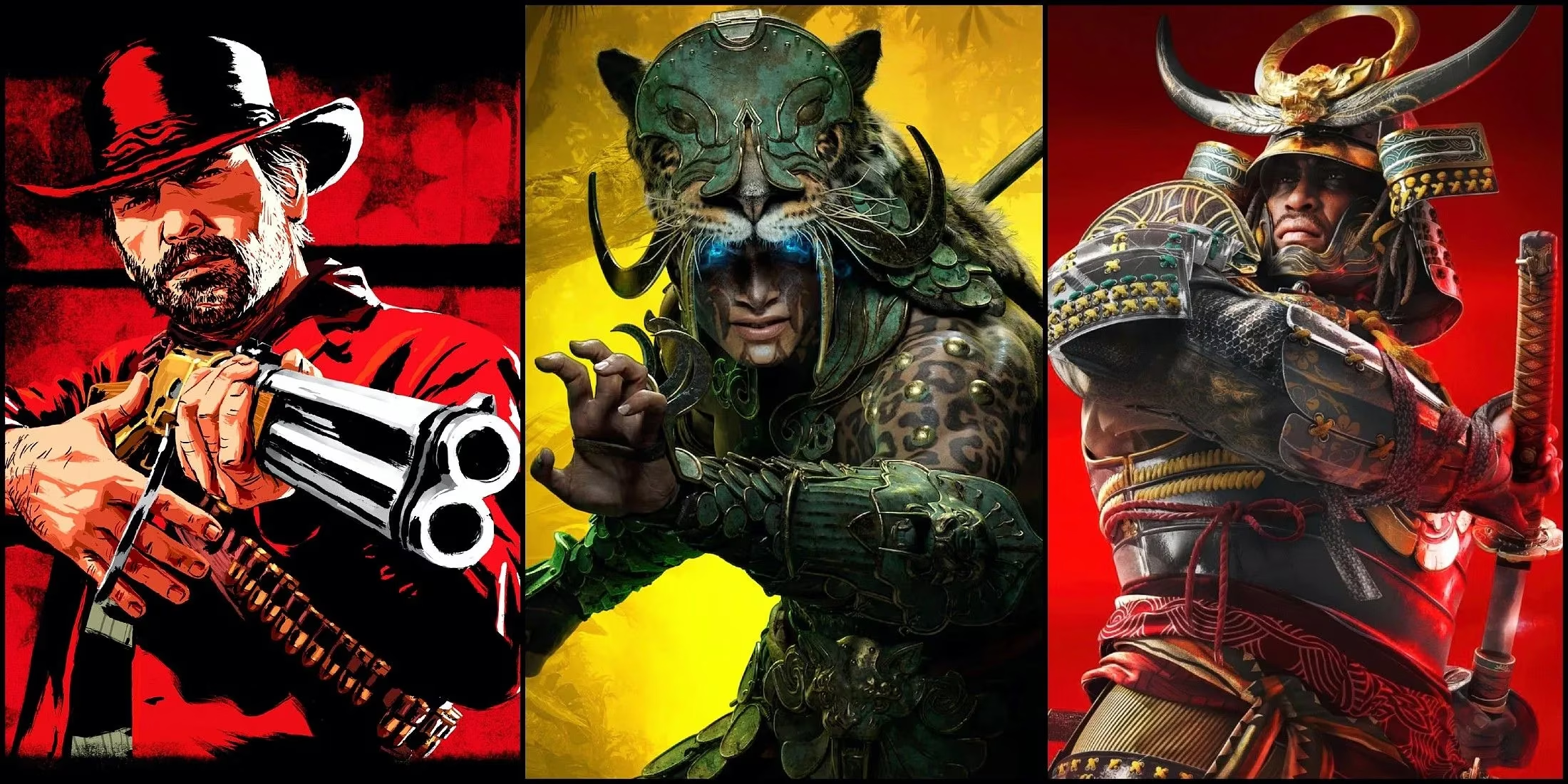
The figures, drawn from public credits on platforms like MobyGames, tell a story of exponential growth. While the core team for a project might be a few hundred, the cumulative count over years of development, including support from subsidiary studios, contractors, and localization experts, can reach astonishing heights. This has created a precarious high-wire act for publishers: a single commercial failure can now threaten the existence of entire studios. So, which games represent the zenith—or perhaps the nadir—of this trend? Let's delve into the titans of team size.
The Pioneers of Scale: Rockstar's Legacy
Long before it became an industry standard, Rockstar Games was pioneering the mega-team approach. Grand Theft Auto V, released in 2013, set a benchmark that few could match. With a core team from Rockstar North and support from studios worldwide, its credits list an astounding 4,700 professional roles. The reported $250 million investment paid off spectacularly, generating $1 billion in sales in just three days. This success paved the way for an even more ambitious project.
Red Dead Redemption 2 followed, solidifying Rockstar's reputation for monumental productions. Realizing a project of this grandeur required unprecedented unity, Rockstar co-opted all its global studios into a single, massive team. A core of 1,600 developers was supported by thousands more, including a small army of voice actors and localization experts. It remains one of the most expensive games ever made, a title it will likely hold only until the release of Grand Theft Auto VI.
The Ubisoft Assembly Line: Modular Marvels (and Mishaps)
No company embodies the modern, distributed development model quite like Ubisoft. With over 40 studios and 18,000 employees, its "modular" approach—where different studios handle distinct parts of a game's world—has produced some of the largest teams in gaming history.
The journey hasn't always been smooth. Skull and Bones stands as a testament to turbulent development. What began in 2013 as an expansion for Assassin's Creed IV: Black Flag morphed through multiple reboots and directional shifts, its budget ballooning along the way. Despite a lukewarm launch in 2025, Ubisoft's commitment remained, with major updates like on-foot combat arriving a year later. Its lengthy, troubled creation involved a vast network of developers across Ubisoft Singapore and other studios.
Ubisoft's other franchises have consistently pushed team sizes upward:
-
Assassin's Creed Series: The flagship series has seen team counts skyrocket with each entry.
-
Origins & Odyssey: ~4,500 credited professionals each.
-
Valhalla: 5,700 roles across 15 studios.
-
Shadows (2025): The peak so far, with a staggering 6,400 professionals credited in a two-hour roll. A core team of 600 at Ubisoft Quebec was supported by numerous studios over four years of development.
-
-
Far Cry 6: This entry saw ten Ubisoft subsidiaries collaborate, following the disastrous Far Cry 5 which itself had around 4,700 credits. Despite the increased scale, it struggled to match its predecessor's success.
-
The Ambitious Collaborations: Ubisoft's Massive Entertainment led two of its most ambitious projects.
-
Avatar: Frontiers of Pandora: A collaboration with Lightstorm Entertainment and Disney, this game delivered a breathtaking world of Pandora. It required a huge, multi-studio effort to realize its first-person alien world, ranking among Ubisoft's largest productions.
-
Star Wars Outlaws: Billed as the first true Star Wars open-world game, it involved Massive's core team of 750+, Lucasfilm Games, and ten other Ubisoft studios. Its development, beginning in late 2019, focused on handcrafted environments to stand out from procedurally generated space games.
-
Other projects, like Watch Dogs: Legion with its ambitious "play as anyone" mechanic, also required vast, multi-studio collaboration, ultimately leading the series to be put on ice after its release.
The Corporate Behemoths: Activision Blizzard's Credit Policy
The landscape shifts when we look at Activision Blizzard, which has a policy of crediting every employee across its vast empire for its major releases. This makes direct comparisons tricky but reveals mind-boggling numbers.
Diablo IV's credits list over 8,700 professional roles. Not all were directly involved in the years-long development, but the scale is undeniable. Driven by its open-world, live-service model and expansions like Vessel of Hatred, its team dwarfed that of Diablo III (4,600 credits), reflecting the immense growth in scope and post-launch expectations over a decade.
The Call of Duty series exemplifies the modern blockbuster assembly line. Gone are the days of a single lead studio. Now, each annual release is a colossal collaboration. For instance:
| Game | Credited Developers | Key Studios Involved |
|---|---|---|
| Call of Duty: Vanguard (Pre-policy) | ~5,500 | Sledgehammer Games, et al. |
| Call of Duty: Black Ops Cold War | ~4,900 | Treyarch, Raven Software, et al. |
| Call of Duty: Modern Warfare III (2025) | 9,000+ | Infinity Ward, Sledgehammer, Raven, et al. |
| Call of Duty: Black Ops 6 (2026) | 9,000+ | Treyarch, Raven, et al. |
Under the new credit policy, recent entries like Modern Warfare III and Black Ops 6 list over 9,000 professionals, placing them at the absolute apex of development team sizes.
A Precarious Future: Quality vs. Sustainability
Looking at these numbers in 2026, one must ask: is this sustainable? The data paints a clear picture of an arms race in human resources. Games are no longer just products; they are perpetual live-service platforms requiring years of support from vast teams. The financial stakes have never been higher, and the pressure on these teams is immense.
While these colossal efforts give us worlds of unprecedented detail and scale, they also concentrate immense risk. The commercial underperformance of titles like Star Wars Outlaws or Avatar: Frontiers of Pandora, despite their massive investments, sends shockwaves through the industry. It begs the question—are we reaching the limits of growth? Could the future see a counter-movement towards more focused, sustainably scoped AAA games, or will the march toward ever-larger teams continue until the economic model breaks?
The story of modern AAA gaming is written in the credits of thousands. It's a story of incredible achievement, but also one of looming uncertainty. As players, we reap the benefits of these vast digital worlds, but we must also wonder about the human and economic cost behind the screen.
Industry analysis is available through Eurogamer, which frequently investigates the evolving scale of AAA game development. Eurogamer's reporting on projects like Assassin's Creed and Red Dead Redemption 2 has highlighted the unprecedented team sizes and the growing concerns about sustainability, crunch, and the long-term viability of such massive undertakings in the gaming sector.
Comments