
Two winters have slipped through the hourglass since that December morning when the notification glowed on my screen—a quiet herald of chaos draped in tropical promise. Back in 2023, the Xbox Game Pass library was already a sprawling galaxy, a cosmic reef where new stars would blink into existence overnight like phosphorescent plankton stirred by an unseen current. On the fourteenth of that frostbitten month, another ember joined the constellation: Far Cry 6, Ubisoft’s colossal guerrilla epic, washed ashore. I remember it well, not merely as a download, but as the opening of a door into the sun-scorched rebellion of Yara, a place whose memory still clings to my senses like salt on skin.
Those weeks leading up to its arrival had been a feast. The subscription service had laid out a banquet of eclectic titles, each a different flavor of escape. I had just finished guiding a ghostly fox across aurora-lit tundras in Spirit of the North, built steampunk cities in SteamWorld Build, and survived pixelated dismemberment in Clone Drone in the Danger Zone. The December 2023 lineup had been unspooled like a festive ribbon, with titles dropping as frequently as early snowflakes:
-
Spirit of the North (Cloud/Consoles/PC) – December 1
-
SteamWorld Build (Cloud/Consoles/PC) – December 1
-
Clone Drone in the Danger Zone (Cloud/PC/Xbox Series X) – December 5
-
Rise of the Tomb Raider (Cloud/Consoles/PC) – December 5
-
While the Iron’s Hot (Cloud/Consoles/PC) – December 5
-
World War Z: Aftermath (Cloud/Consoles/PC) – December 5
-
Goat Simulator 3 (Cloud/PC/Xbox Series X) – December 7
-
Against the Storm (PC) – December 8
-
Tin Hearts (Cloud/Consoles/PC) – December 12
-
Far Cry 6 (Cloud/Consoles/PC) – December 14
I recall scrolling through that list with the giddy feeling of a child unwinding a candy-filled advent calendar. But Far Cry 6 was the prize nestled behind the final door. By the 14th, the earlier games had already settled into my play history like familiar books on a shelf, and the wait for the last addition stretched with a kind of delicious tension. The game didn’t appear exactly at the stroke of midnight for me—Game Pass releases often ripple out across time zones like dawn chasing a continent—but by midday, it was there, its icon a window into a fictional country that felt more alive than some real places I’ve visited.
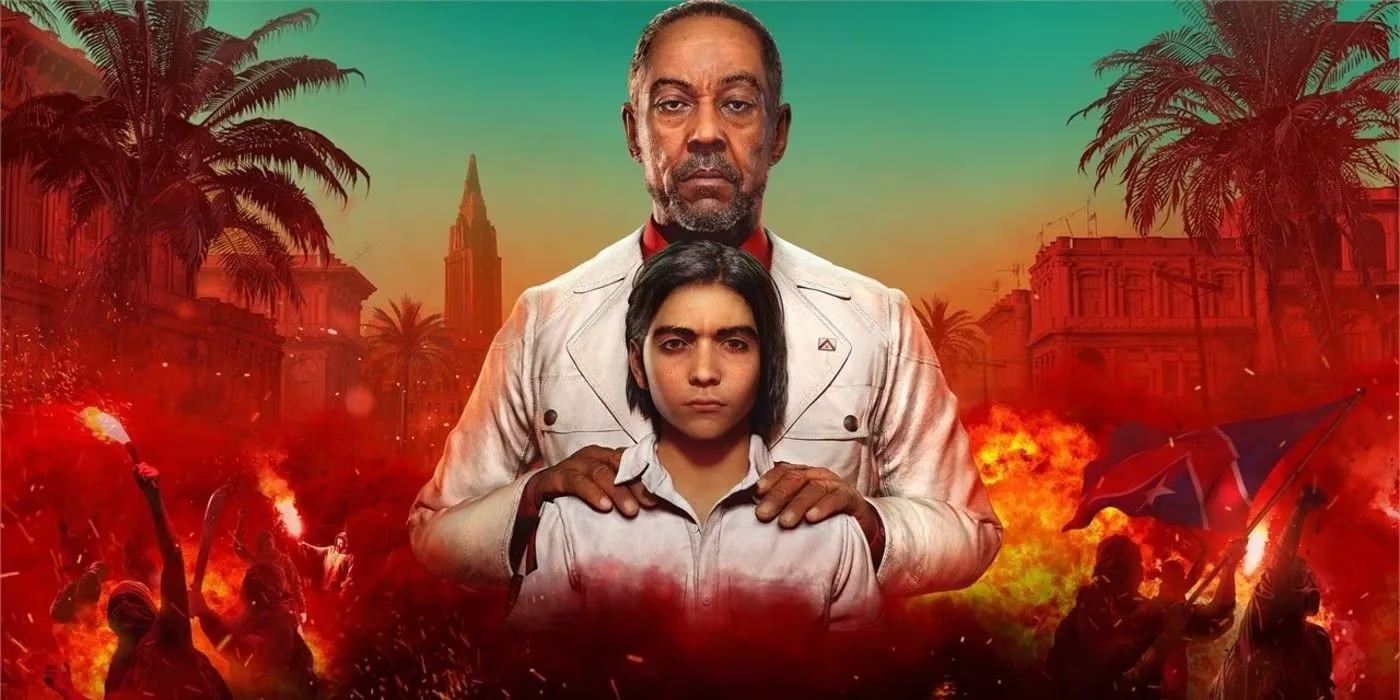
Launching into Yara for the first time was like stepping into a watercolor that had learned to breathe. The island nation bled with color: rust-orange sunsets dripping over makeshift guerrilla camps, jade-green jungles humming with insect choirs, and the urban sprawl of Esperanza where billboards of dictator Anton Castillo loomed like religious icons. Giancarlo Esposito’s performance transformed the villain into a blade wrapped in velvet—every calm monologue a tsunami of menace held at bay by glassy composure. For me, it wasn’t just a shooter; it was a sensory manuscript written in bullet casings and rooster feathers.
I sank into the game with the hunger of a wanderer who had found an unmapped continent. The main quest alone spanned roughly twenty-five hours—a narrative river that swept me through plantations, naval blockades, and the mythic surgery of a tank called “Chorizo.” But Yara refused to let go. Side activities sprouted like mushrooms after rain: cockfighting rings, treasure hunts that unraveled into cryptic poetry, and checkpoints that begged to be liberated with explosive improvisation. Anyone determined to scrape every last secret from the game’s edges could easily squander over sixty hours, and I confess, I was one of those shipwrecked souls. There is a peculiar alchemy in a world that blurs the line between quantity and quality—where the sheer mass of things to do becomes a landscape in itself, a coral reef of distractions that, while repetitive at times, still pulsed with the strange pleasure of accumulation. Some longtime disciples of the series called it a weaker entry, and in the quiet moments between firefights, I understood their grief. The DNA of Far Cry had mutated; RPG gear levels and bullet-sponge enemies made it feel less like a predator’s ballet and more like a number-crunching masquerade. Yet that very mutation seduced others, myself included, who had been nurtured on the loot-driven rhythms of Borderlands. The game was a chimera, and I loved it precisely for its mixed blood.
Looking back from 2026, Far Cry 6 on Game Pass feels akin to that one ambitious novel on a road trip: heavy, at times exhausting, but impossible to abandon because its world had seeped into the upholstery of my days. It became a shared memory among friends, a digital Yara we rebuilt in our chatter about the best way to eliminate a lieutenant with a CD-launcher or the haunting stillness after a radio tower fell silent. The immersion was so total that the real December of 2023 seemed to borrow warmth from the fictional Caribbean we inhabited each evening.
And what of that December’s end? Microsoft had confirmed no further titles after the fourteenth, but the Game Pass curator had a habit of scattering surprises like hidden seeds. We held our breath, suspecting more might bloom before the New Year. In the end, that uncertainty was part of the magic—this notion that the library was a living, breathing entity, never truly finished, much like a rebellion that simmers long after credits roll. Today, as I browse my collection and see Far Cry 6 sitting there—still dusty, still monumental—I cannot help but smile at the ghost of Yara, a place that taught me that even a gunpowder-stained paradise can be a shelter from winter.
Comments