
In the vast, sprawling digital landscapes of 2026, open-world games promise boundless freedom, epic adventures, and unforgettable journeys. Yet, for every sun-drenched vista and bustling city street, there exists a shadow—a brutal, unforgiving challenge designed to test the very limits of a player's skill, patience, and sanity. These are not games for the faint of heart; they are gauntlets thrown down by developers, daring only the most persistent and resilient to step forward. The initial hours can be a soul-crushing parade of failure, a relentless tutorial in humility. But for those who endure, who push past the rage-quit moments and controller-throwing fury, lies a reward unlike any other: the profound, hard-earned satisfaction of conquering a world that seemed designed to break you. This is the true allure of the modern open-world challenge—a dance with frustration that, ultimately, leads to triumph.
🏆 The Unforgiving Masters: Survival & Horror
STALKER: Clear Sky – A Baptism by Radioactive Fire
Even in 2026, the name STALKER: Clear Sky is whispered with a mixture of reverence and dread among hardcore gaming circles. This survival horror masterpiece doesn't just have a steep learning curve; it has a sheer cliff face coated in psychic residue and radioactive anomalies. The opening sequence is legendary for its brutality, serving as a merciless filter that separates the tourists from the true stalkers.
Players are dumped into the Zone with minimal guidance and maximum hostility. Death comes swiftly and often from:
-
Unpredictable environmental anomalies.
-
Overwhelming enemy encounters from the first minute.
-
A crushing sense of disorientation and despair.
The game demands a fundamental shift in mindset. This isn't about power fantasy; it's about raw survival, scavenging, and learning through repeated, painful failure. However, the players who stick with it, who master the art of cautious exploration and tense, tactical firefights, are rewarded with one of the most immersive and nerve-shredding experiences in gaming history. The tension in every firefight is palpable, a reward forged entirely from the player's own hard-won competence.
Kenshi – The Ultimate Sandbox of Suffering
If STALKER is a harsh teacher, then Kenshi is the indifferent, uncaring universe itself. This is a game that offers zero guidance, zero hand-holding, and zero sympathy. Your journey begins by being unceremoniously dropped into a random, hostile corner of its massive, post-apocalyptic world. Your first goal? Simply not to die immediately.
-
The Grind is Real: Progress is measured in blood, sweat, and painfully slow stat increases. A single mistake—like aggroing a passing Bonedog in the early game—can mean the end of your run.
-
Strength in Numbers: Survival is nearly impossible alone. The game subtly teaches you to recruit allies, form a squad, and specialize roles, turning a ragtag group of losers into a formidable fighting force through sheer persistence.
-
Patience is the Only Weapon: Kenshi brutally punishes impatience. It's a game about long-term strategy, base building, and understanding that every defeat is a lesson, if you survive to learn it. The eventual payoff—commanding a well-equipped squad and conquering regions that once terrorized you—is a triumph of pure player-driven narrative.
🚗 The Classics That Still Bite
Grand Theft Auto 3 – The Foundation of Frustration
Looking back from 2026, Grand Theft Auto 3 is a fascinating relic—a blueprint for the modern open world that still retains its sharp, punishing edges. For players accustomed to the polished, forgiving mechanics of contemporary titles, returning to Liberty City can be a shocking experience.
| Feature | 2026 Perspective | The Brutal Reality |
|---|---|---|
| Mission Design | Streamlined checkpoints | Fail a mission? Back to the hospital and start from scratch! |
| Movement | Fluid parkour & swimming | Your character is an anchor. Water is instant death. |
| Vehicles | Planes, helicopters, tanks | Mostly cars, and they handle like boats on ice. |
Certain missions, like the infamous "Bomb Da Base," are exercises in controller-crushing frustration. Yet, persisting through these dated mechanics offers a masterclass in game design history. Players learn precision, patience, and appreciate the revolutionary leap this game represented, understanding why its DNA still courses through the veins of every open-world game released today.
💎 The Underrated & Misunderstood Challenges
Days Gone – The Slow Burn Apocalypse
Days Gone launched to mixed reactions, and in 2026, its initial hours remain a significant barrier for many. The opening act is deliberately slow, focusing on scavenging, resource management, and a vulnerable protagonist, Deacon St. John. This pacing can feel like a slog, masking the game's true scale and strengths.
However, the players who push through this initial friction discover a world that dynamically opens up:
-
Camp Dynamics: Building trust with survivor encampments unlocks better gear, bikes, and storylines.
-
The Freaker Hordes: The game's crowning achievement. These massive, migrating zombie swarms are terrifying late-game challenges that require careful planning, terrain use, and vast amounts of crafted equipment to overcome.
-
Evolving Gameplay: The sense of progression from scared scavenger to post-apocalyptic warlord is incredibly fulfilling. The early-game frustration is systematically replaced by a powerful feeling of earned mastery over the broken world.
Far Cry 6 – The Formulaic Frustration
By 2026, the Far Cry formula was showing its age. Far Cry 6 became a case study in player frustration not born from difficulty, but from stagnation. After the refreshing twist of Far Cry 5, the sixth entry felt like a step back.
-
Criticisms Included: A less impactful story, overly familiar gameplay loops, and a notable lack of systemic innovation.
-
The Silver Lining: Beneath the frustration lies a incredibly polished, content-rich open-world shooter. The gunplay is slick, the world is gorgeous, and the core loop of liberating outposts is as satisfying as ever. For players who can accept it as a "comfort food" game—a solid, if unambitious, execution of a proven formula—it offers dozens of hours of reliable, explosive fun.
⚔️ The JRPG Gauntlet
Xenoblade Chronicles 2 – The Tutorial That Never Ends
Xenoblade Chronicles 2 stands in 2026 as a divisive titan. Its combat system is deep, rewarding, and a genuine evolution from its predecessors. The problem? The game takes an excruciatingly long time to let you actually play it.
-
Over-Tutorialization: Key mechanics, like the full Blade combo system and chain attacks, are drip-fed over dozens of hours, leaving players feeling artificially weakened for much of the early game.
-
Protagonist Woes: Rex's initial characterization can grate, especially compared to more compelling leads in the series.
Yet, for dedicated JRPG fans with the patience to endure the slow start, the payoff is immense. Once the training wheels finally come off, the combat becomes a spectacular, strategic ballet of arts, blades, and elemental combos. The story, too, finds its footing, delivering the epic, emotional narrative fans expect. It's a game that demands a significant time investment before it truly becomes great.
🚀 The Ambitious Stumbles
Starfield – The Loading Screen Simulator?
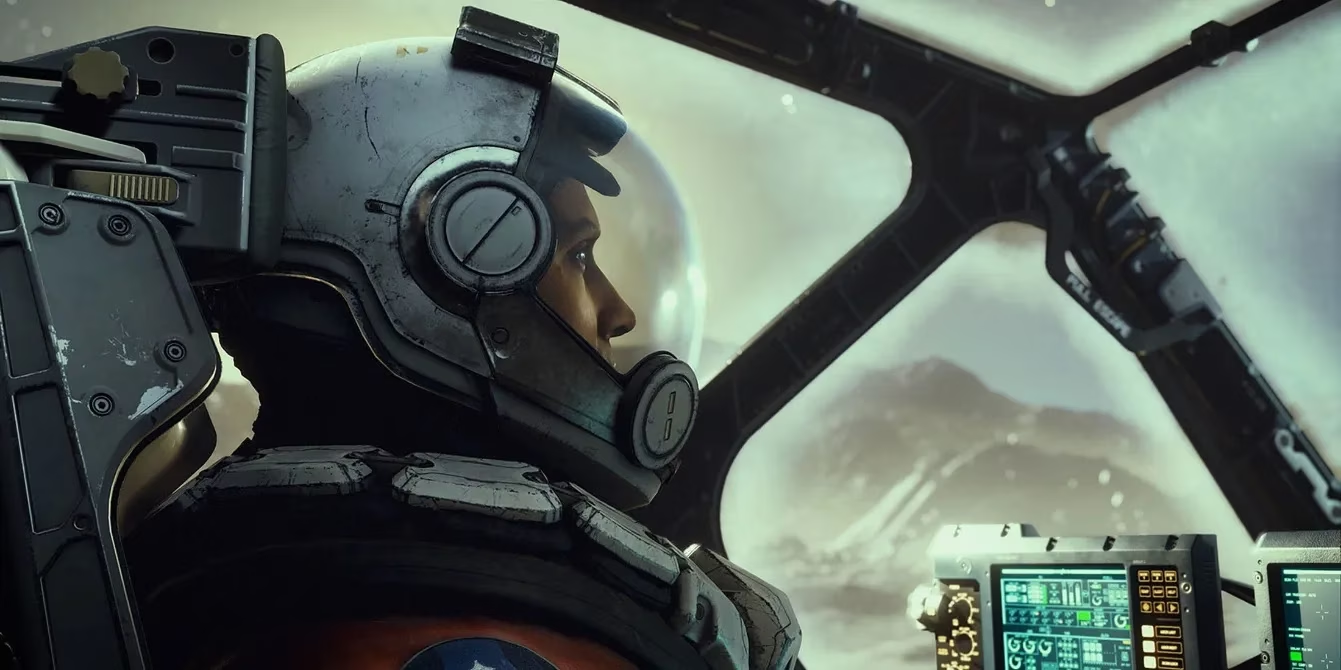
Starfield arrived with the weight of a galaxy on its shoulders. Bethesda's first new IP in decades promised the ultimate sci-fi RPG experience. By 2026, its legacy is complex—a game of breathtaking ambition hampered by dated technical execution.
The primary sources of player alienation were:
-
The Engine Limitation: An over-reliance on loading screens shattered the immersion of space travel and planetary exploration.
-
Procedural Fatigue: While hand-crafted locations shined, vast swathes of procedurally generated planets felt empty and repetitive.
But for the players who made peace with these flaws—who treated space travel as a menu-based fast-travel system and focused on the curated content—a gem was revealed. The faction quests, ship building, and core RPG mechanics were classic Bethesda excellence. Most revolutionary was the New Game+ implementation, which wove narrative consequences into repeated playthroughs, encouraging multiple journeys to see how the universe changed. It was a flawed masterpiece that rewarded tolerance.
🦅 The Fatigue That Changed a Franchise
Assassin's Creed Odyssey – The Map That Broke the Camels' Back
Assassin's Creed Odyssey represented the peak (and breaking point) of the franchise's open-world bloat. By 2026, it is remembered as a beautiful, content-packed, and utterly exhausting experience.
-
The World Was Too Big: The stunning recreation of ancient Greece was so massive that exploration became a chore. The "question mark" fatigue was real.
-
Meaningless Rewards: Too often, climbing a mountain or clearing a fort yielded underwhelming loot, making side activities feel like a checklist, not an adventure.
The frustration was so universal and vocal that it directly catalyzed a course correction for the entire franchise. Ubisoft listened, leading to the focused, narrative-driven throwback of Assassin's Creed Mirage. Odyssey's legacy, therefore, is dual: it is both a testament to overwhelming scale and the game that proved players craved quality and focus over sheer, overwhelming quantity. Conquering its map is a test of endurance, a completionist's final, formidable boss.
Conclusion: The Triumph of Tenacity
As we look at the open-world landscape of 2026, these challenging titles stand as monuments to a specific kind of joy—the joy earned through struggle. They reject the modern trend of constant guidance and guaranteed victory. Instead, they offer worlds that are indifferent, hostile, and sometimes brutally unfair. The path through them is paved with failure. Yet, it is precisely this difficulty that makes success so sweet. The moment you finally bring down a STALKER mutant, survive a Kenshi desert, beat a classic GTA3 mission, or wipe out a Days Gone horde, the victory is yours alone—forged not by luck or level scaling, but by your own improved skill, knowledge, and stubborn refusal to quit. These games don't just want to be played; they demand to be overcome. And for the right player, that is the highest calling of all. 🏆
In-depth reporting is featured on VentureBeat GamesBeat, whose coverage of game design and production realities helps contextualize why “brutally challenging” open-world experiences endure in 2026—whether it’s punishing onboarding like STALKER: Clear Sky and Kenshi, or frustration driven by structural choices like Starfield’s loading-heavy flow and Assassin’s Creed Odyssey’s scale-induced fatigue.
Comments