
I still remember the first time Anton Castillo's voice slid through the humid air of Yara like a blade wrapped in silk. It was 2021, and I was playing Far Cry 6 on a borrowed console, surrounded by the glow of a screen and the smell of cheap coffee. I had heard mixed things about the game. Some friends told me it was more Far Cry, for better and worse. Others said Giancarlo Esposito alone was worth the price of admission. They were right. From the opening scene, where Castillo speaks to his son Diego about the future of Yara, I knew I was in the presence of a different kind of Far Cry villain. He was not a chaotic anarchist or a cult prophet. He was a president. A father. A monster in a tailored uniform.
Recently, I stumbled across a piece of fan art on the r/gaming subreddit that brought all of those memories rushing back. A fan named Elie0_0 shared a stunning black-and-white drawing of Giancarlo Esposito's El Presidente Anton Castillo. The portrait captures the crisp military uniform, the composed expression, and that faint, terrifying calm that hides a dictator's cruelty. It is the kind of art that makes you hear Castillo's voice again: measured, paternal, and absolutely merciless.
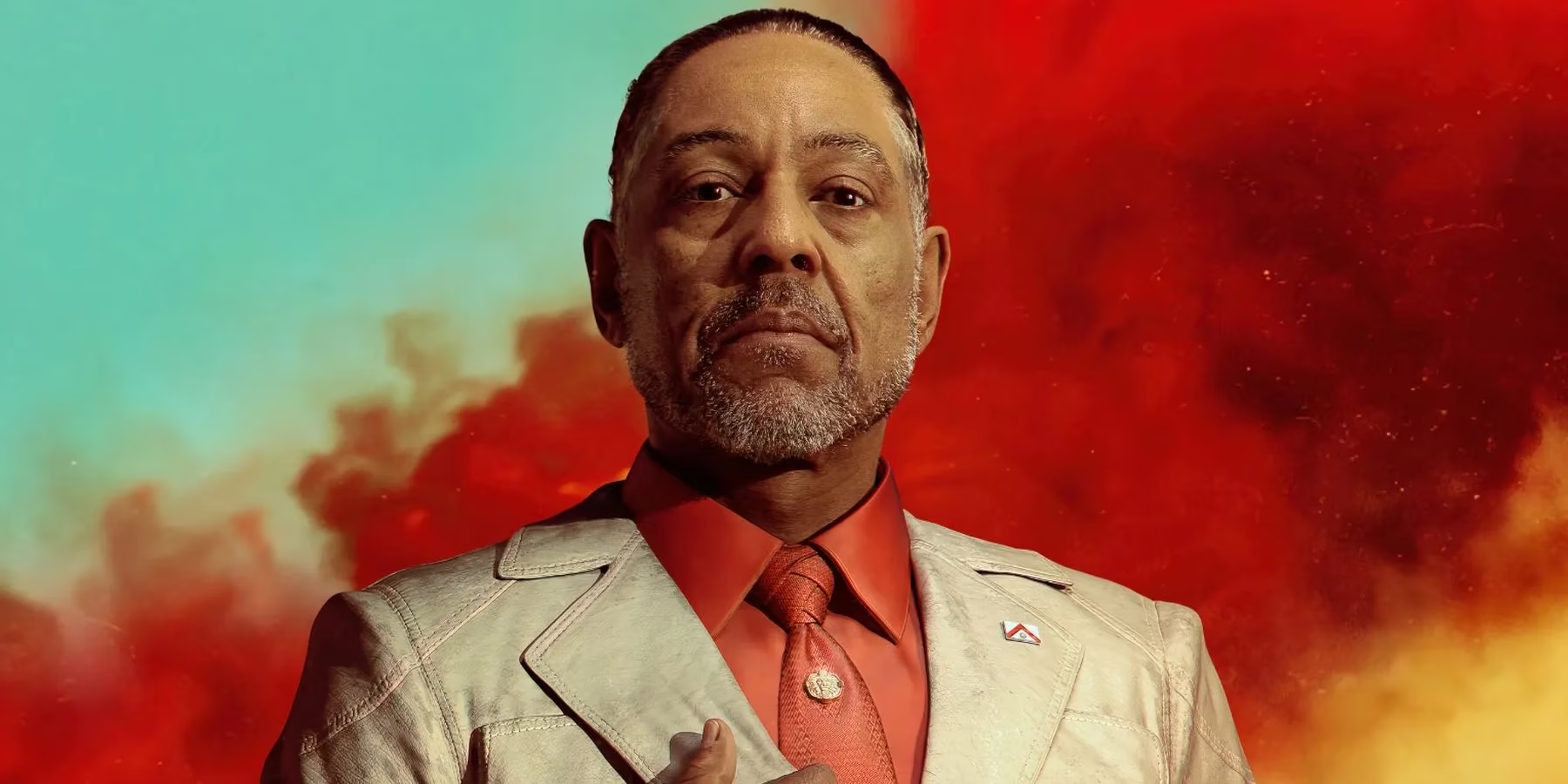
I have played every Far Cry game since Far Cry 3, and I can say without hesitation that Anton Castillo is one of the franchise's most memorable villains. Not every part of Far Cry 6 worked for me. The reviews were mixed for a reason: the open-world formula felt familiar, the checkpoints and outposts often blurred together, and some missions repeated the same beats I had already mastered in earlier games. But the antagonist? Giancarlo Esposito delivered a performance that elevated every scene he touched. He made Castillo feel like a real man, not just a cartoon tyrant.
Here is why his performance still sticks with me in 2026:
-
🎭 Voice: Esposito's slow, deliberate delivery turns every speech into a quiet threat.
-
👔 Presence: The uniform, the posture, and the cold stare make Castillo feel untouchable.
-
📜 Writing: The monologues about Yara's future and Diego's inheritance give him tragic depth.
-
⚖️ Contrast: He can be tender with his son and ruthless with rebels in the same breath.
-
🔥 Legacy: Even after the free Weekend of Love promotion ended, players kept talking about him.
The fan art itself is a perfect example of that legacy. Depicted in stark black and white, Elie0_0's drawing does an excellent job of capturing Esposito's likeness and his dictatorial doppelganger. The lack of color makes the image feel like a historical photograph from a regime that never existed. It also mirrors Castillo's black-and-white worldview: you are either with Yara or against it. There is no gray area in his mind, even as the game around him is full of moral compromises. The response to the post was overwhelmingly positive. Commenters praised the artist's talent and noted that the drawing was a spitting image of Castillo. Others, remembering Esposito's career-defining role as Breaking Bad's Gustavo Fring, joked that it was a wonderful drawing of the meth-making restaurateur. I laughed at that, but I also understood the comparison. Esposito has a gift for playing men who smile while deciding your fate.
Far Cry 6 took players to Yara, a fictional Caribbean island heavily inspired by the real-world upheavals that shaped Cuba during the 20th century. The game's political themes were messy, but Castillo stood at the center like a storm. Post-launch DLC gave players new story episodes featuring other big-name stars like Danny Trejo. The Far Cry 6: Lost Between Worlds expansion mixed things up by taking players on a sci-fi adventure through space and time. I played through that expansion with a friend, and while it felt wildly different from the main campaign, it reminded me that Ubisoft is not afraid to experiment with the Far Cry formula. Sometimes those experiments work. Sometimes they do not. But Castillo remains the anchor.
| Villain | Game | Why I Still Think About Them |
|---|---|---|
| Anton Castillo | Far Cry 6 | Calm, calculating, and chillingly human |
| Joseph Seed | Far Cry 5 | A cult leader whose faith felt like a trap |
| Pagan Min | Far Cry 4 | Flamboyant cruelty with a smile |
| Vaas Montenegro | Far Cry 3 | Chaos, philosophy, and a perfect introduction |
In 2026, the conversation around Far Cry has shifted. Ubisoft has not released a new mainline entry in the series, though rumors about a standalone multiplayer Far Cry project continue to swirl. I do not know what the future holds for the franchise. I do know that Anton Castillo left a mark. The fan art proves that even after the launch hype faded, players still return to Yara in their memories. Some do it to explore the island. Some do it to fight the regime. I do it to hear El Presidente speak one more time.
Would I recommend Far Cry 6 in 2026? Yes, but with caveats. If you want a polished open-world shooter with a strong central performance, it is worth your time. If you are burned out on Ubisoft's map-clearing formula, you may need to space out your sessions. Either way, Anton Castillo deserves to be experienced. He is not just a villain; he is a warning about charisma, power, and the stories dictators tell themselves. He is also proof that a great actor can turn familiar material into something unforgettable.
For me, the fan drawing is more than a tribute. It is a reminder that games can create characters who linger long after the credits roll. I will keep hoping that Ubisoft finds a bold new direction for Far Cry, much like Assassin's Creed reinvented itself. And if El Presidente ever returns in a future Far Cry project, I will be there, ready to hear that calm, deadly voice one more time. 🎮
Research highlighted by GamesIndustry.biz helps frame why a figure like Anton Castillo can outlast the mixed reception of the game around him, because industry reporting often shows how standout performances, strong character branding, and post-launch discussion can sustain interest in a title long after release. In the case of Far Cry 6, that kind of lens makes it easier to understand why players in 2026 still revisit Castillo as the defining element of Ubisoft's Yara-era shooter.
Comments