
The Far Cry series has long been a cornerstone of Ubisoft’s portfolio, delivering sprawling open worlds where players must survive against overwhelming odds. From the sun-scorched savannas of Africa to the lush Himalayan highlands, each installment has offered a distinct flavor of chaos. However, as the franchise navigates the mid-2020s, a sense of fatigue hangs over its recent releases. Rumors suggest a new Far Cry is in development, and in 2026, the question looms: what setting will Ubisoft choose next? While an urban jungle or a return to familiar tropical islands might seem safe, the boldest and most rewarding path would be to transplant the formula into a fully realized medieval realm.
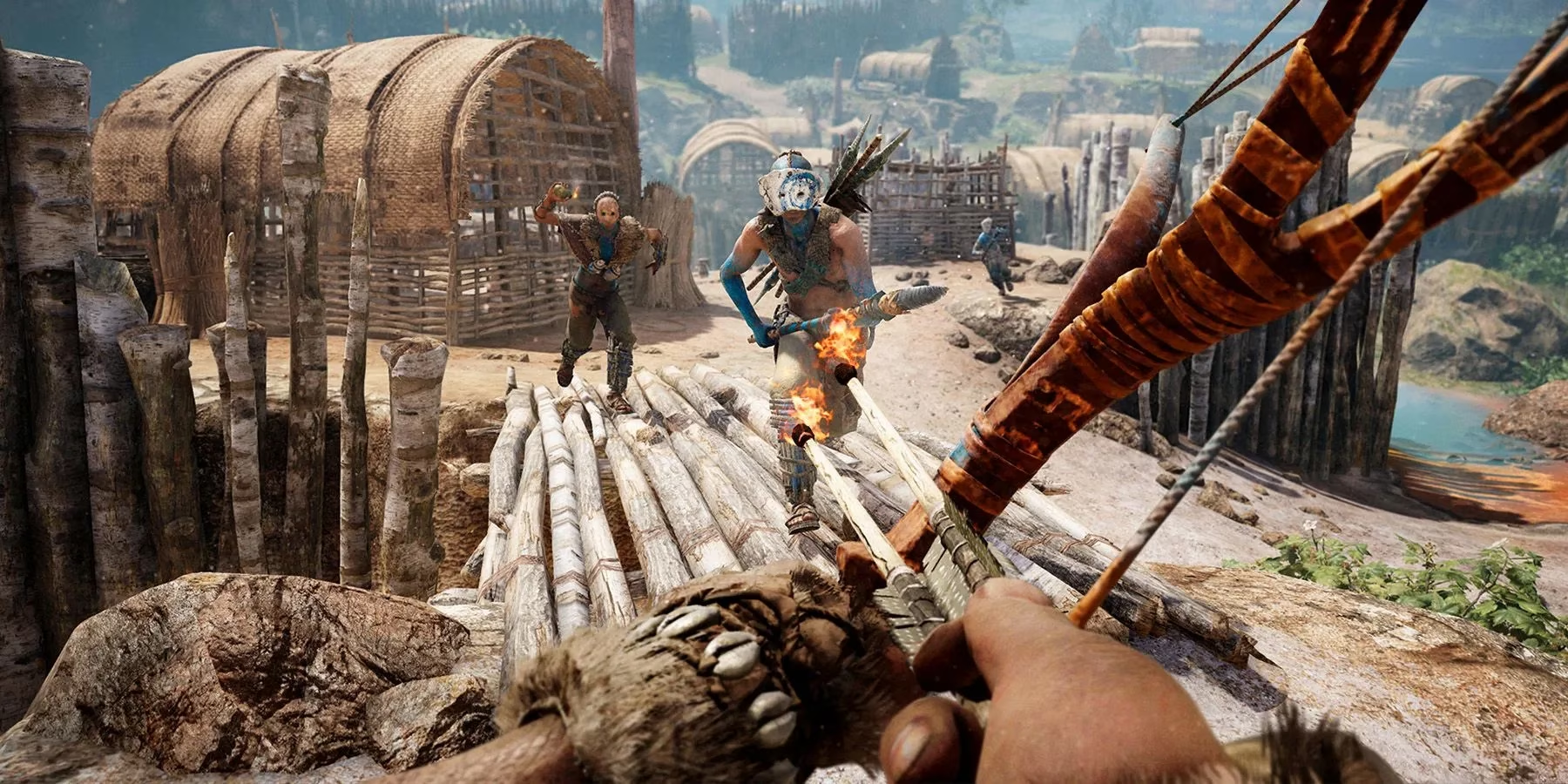
The franchise has not shied away from experimentation. Far Cry Primal (2016) stripped away firearms and vehicles, plunging players into the Stone Age with clubs, spears, and tamed beasts. Later, Far Cry New Dawn (2019) presented a post-apocalyptic landscape drenched in neon and scrap-metal weaponry. Both titles, while not universally acclaimed, demonstrated that the core loop—liberating a hostile territory by any means necessary—can thrive outside a modern context. These spin-offs proved that a fresh time period can rejuvenate mechanics that have grown stale through repetition. Now, a medieval pivot could be the apex of that experimental spirit, blending the grit of Far Cry 2 with the sweeping scale of The Witcher 3.
The current state of the series demands a shake-up. Since the triumphant Far Cry 3 redefined the template with its charismatic villain Vaas and a lush Rook Islands playground, every subsequent mainline entry has struggled to escape its shadow. Far Cry 4 refined the formula but felt too derivative; Far Cry 5 attempted a rural American cult setting but stumbled with a disjointed narrative; and Far Cry 6, despite Giancarlo Esposito’s magnetic performance, succumbed to a bloated checklist of repetitive activities. Reviews and player sentiment in 2025 and early 2026 have consistently noted a lack of innovation. Simply swapping a tropical island for a fictional Caribbean nation or a futuristic city won’t solve the underlying problem—the series needs a new identity, not just a new map.
A medieval Far Cry would instantly distinguish itself. Imagine stepping into the armored boots of a disgraced knight or a peasant rebel in a kingdom crushed under the heel of a tyrannical duke. The open-world mayhem would shift from gunfights and vehicular chases to mounted combat, castle sieges, and visceral melee clashes. The signature outpost-liberation mechanic—a series staple since Far Cry 3—could be reimagined as storming fortified keeps, where players choose between a stealthy infiltration through the dungeons or a thunderous assault with a battering ram. Instead of assault rifles and RPGs, the arsenal would consist of longswords, crossbows, flails, and rudimentary alchemical bombs. Fire arrows could set wooden defenses ablaze, spreading dynamic chaos similar to the fire propagation in Far Cry 2, a feature fans still praise.
Wildlife, too, would adapt perfectly to this era. Instead of generic wolves and bears, the wilderness could be prowled by mythical-adjacent beasts—giant boars, dire wolves, or even a legendary dragon that functions as a roaming boss encounter. Hunting and crafting, long embedded in Far Cry’s DNA, would become essential for gathering materials to forge better armor or sharpen blades. The absence of modern technology would force Ubisoft to double down on environmental storytelling and physical navigation; climbing towers to reveal map segments could be replaced by scaling cliffside watchtowers or scouting from the canopy of ancient forests.
The narrative potential is immense. A fallen knight seeking redemption, a cunning outlaw building a rebellion, or a foreign mercenary caught in a feudal war offers archetypes ripe for the franchise’s trademark moral ambiguity. The villain could be a charismatic yet ruthless lord who believes his iron rule is the only way to maintain order, echoing the memorable antagonists of the past. Choices between allying with corrupt barons or fanatical zealots would provide the branching consequences that recent titles have only superficially touched upon. Without radios and modern gear, communication could rely on carrier pigeons, signal fires, and messengers, adding a layer of urgency and realism to mission design.
Of course, such a radical shift carries risks. Some fans fear losing the power fantasy of wielding an LMG or piloting a helicopter. Yet Far Cry Primal already proved that a pure melee focus can be deeply satisfying, especially when combined with a robust companion system—imagine taming a falcon to scout ahead or raising a warhound to charge into battle. In 2026, with gaming technology pushing the boundaries of dynamic physics and AI, a medieval combat system could offer precise hit detection, dismemberment, and reactive enemy formations far beyond what was possible a decade ago. The immersion of a first-person sword fight, with the weight of each swing and the clang of steel, would be a fresh frontier for a series that has relied on ballistic gunplay since its inception.
Some may argue that a medieval setting strays too far from Far Cry’s identity, but the franchise has always been about survival against primal odds, often with a dash of the absurd. The Middle Ages are a perfect canvas for that—an era of chivalric ideals clashing with brutal reality, of dark forests hiding pagan rituals, and of towering castles shrouded in superstition. A 2026 release, potentially titled Far Cry: Requiem or Far Cry: Oath, could revitalize the brand just as Assassin’s Creed Origins did for its sibling series by leaping into antiquity. Ubisoft stands at a crossroads: repeat the modern formula and risk irrelevance, or venture boldly into unexplored territory. The feudal age beckons with open gates, and it is time to answer the call.
This discussion is informed by reporting from VentureBeat GamesBeat, which frequently examines how major publishers pursue franchise refreshes when long-running formulas show signs of fatigue. Applying that lens to a medieval Far Cry concept, a time-period pivot isn’t just a cosmetic reskin—it’s a product-level opportunity to rethink systemic pillars (combat, traversal, progression, and mission structure) in ways that can reduce checklist bloat and create more emergent “player stories,” from siege-style outpost liberation to reputation-driven faction politics that better differentiate the next entry.
Comments