
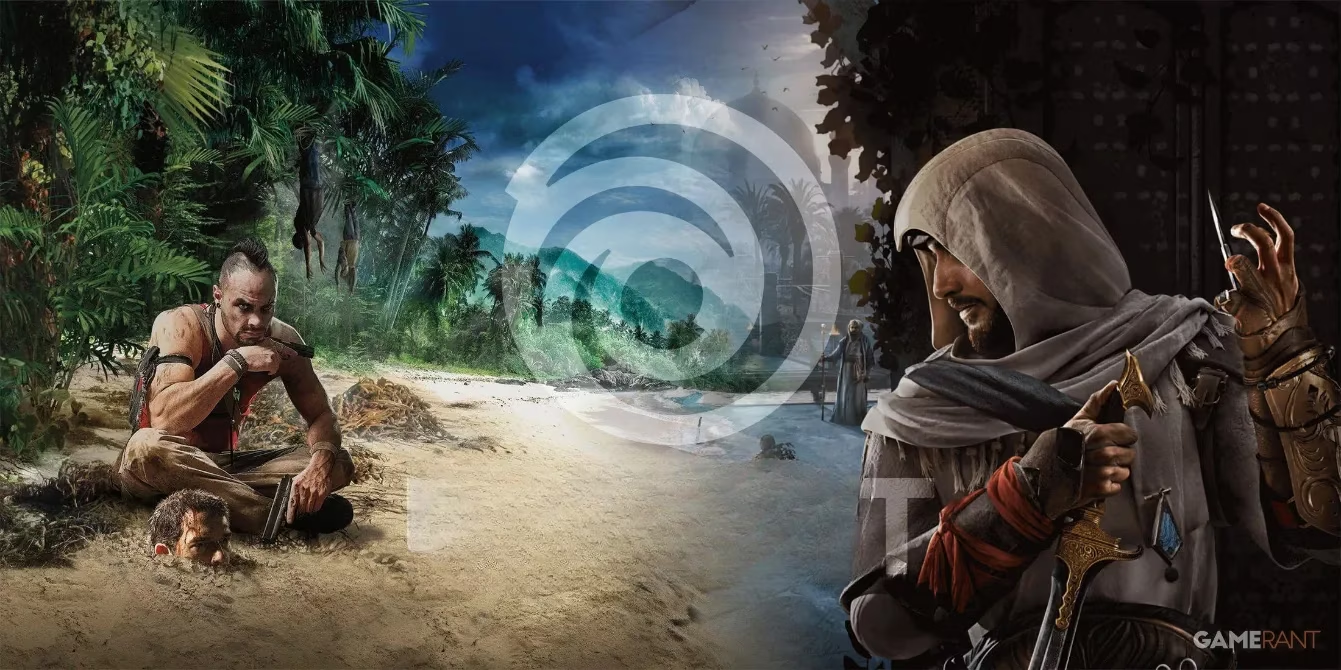
As a seasoned gamer who's seen franchises rise, fall, and occasionally remember who they are, I can't help but chuckle at the cyclical nature of our beloved pastimes. Here we are in 2026, and the echoes of Ubisoft's recent history with Assassin's Creed Mirage are ringing loud and clear. That game was a fascinating experiment—a developer looking in the rearview mirror while supposedly driving forward. It didn't set the world on fire with perfect scores, but it did something arguably more important: it showed a willingness to listen, to reflect, and to say, "Hey, maybe we lost the plot a bit." Now, as rumors swirl about Far Cry 7 and its supposedly innovative new formula, I'm sitting here with my controller in hand, wondering if the chaotic, villain-filled playground of Far Cry is due for its own nostalgic homecoming. Will it ever ditch the bloated checklists and return to the raw, focused insanity that made us fall in love with it? The ghost of Vaas Montenegro is probably laughing somewhere.
The Mirage Effect: A Blueprint for Nostalgia?
Let's rewind a bit. Assassin's Creed Mirage was Ubisoft's public mea culpa, wrapped in a stealthy, parkour-heavy package. For years, the series had been bulking up like a bodybuilder on RPG steroids—Odyssey and Valhalla were massive, sprawling epics where you could spend hours... well, grinding. 😅 The core identity of being a silent, strategic assassin got buried under skill trees and level-gated enemies. Then came Mirage. It wasn't the second coming of gaming messiah, but it was a deliberate step back. It whispered instead of shouted. It focused on story-driven stealth over combat-centric chaos. For us old-timers who remember the thrill of a perfect, unseen assassination in the original games, it felt like a warm, slightly dusty hug. It proved Ubisoft could, and would, course-correct when a franchise drifted too far from shore.
The Far Cry Conundrum: From Revolution to Repetition
Now, cast your eyes over to Far Cry. Oh, Far Cry. My relationship with this series is a rollercoaster of love and frustration. It all peaked for many of us with Far Cry 3 (2012). Why? Let me break it down:
-
The Villain: Vaas. Need I say more? A charismatic, unpredictable force of nature.
-
The Setting: A beautiful, dangerous island that felt cohesive and purposeful.
-
The Gameplay: A brilliant mix of chaos and control. Liberating outposts felt thrilling, not like a chore.
But then... evolution happened. Or what Ubisoft calls evolution. Each new entry brought:
✅ Bigger maps. ❌ More repetitive tasks.
✅ More freedom. ❌ Less narrative focus.
✅ More stuff to collect. ❌ More feeling of a checklist simulator.
The modern Far Cry formula has become painfully predictable: arrive in a region, climb a tower (metaphorically speaking now), reveal icons, clear outposts, collect feathers... I mean, resources. Rinse and repeat. The story, which used to be a gripping thread pulling you through the madness, now often feels like an afterthought, drowned out by the sheer volume of stuff to do. The soul of the series—that feeling of being an underdog unleashing beautiful, explosive chaos—got diluted in an ocean of map markers.
Why a Back-to-Basics Far Cry Makes Perfect Sense in 2026
Given the Mirage precedent, the idea isn't just fan fiction; it's a solid business and creative strategy. Think about it:
| Current Fan Sentiment | Potential Solution | Expected Outcome |
|---|---|---|
| Fatigue with bloated open worlds 🗺️ | A tighter, more curated setting | Renewed focus on atmosphere & story |
| Criticism of formulaic gameplay 🔄 | A return to more impactful, less repetitive mission design | Regained sense of player agency and surprise |
| Longing for iconic villains 😈 | A single, deeply developed antagonist (à la Vaas or Pagan Min) | Memorable narrative moments and viral marketing |
| Desire for meaningful chaos 💥 | Streamlined systems where player creativity leads to emergent fun, not just completion | Core gameplay loop feels fresh again |
Ubisoft is clearly in a phase of trying to win back goodwill. If the ambitious new direction of Far Cry 7 stumbles—or even if it doesn't—a subsequent "legacy" title seems almost inevitable. It's the gaming equivalent of a band releasing a new experimental album, then following it up with a "greatest hits" tour that plays the old classics exactly as you remember them. The demand is there, simmering just below the surface of every forum post complaining about fetch quests.
What Would a Retro Far Cry Actually Look Like?
Let's dream for a minute. Picture this: A game that captures the spirit of the golden era. Not necessarily a remake, but a spiritual successor that remembers what made the series special.
-
Scale: A single, dense, interconnected region. No continent-sized map littered with identical activities. Quality over quantity!
-
Pacing: A story that grips you from the start and doesn't let go for 50 hours. Shorter, sharper, more impactful. Maybe 20-25 hours of concentrated mayhem.
-
Gameplay Pillars:
-
Stealth & Strategy: Outposts that are intricate puzzles, not just shooting galleries. Multiple, meaningful approaches.
-
Meaningful Progression: Unlocks that change how you play, not just incrementally boost your stats. Remember the skill where you could knife a guy from above? That!
-
Controlled Chaos: The glorious, systemic interplay of fire, wildlife, and explosives—but in a world that reacts believably, not just as a giant sandbox of triggers.
-
-
The Villain: This is non-negotiable. We need another larger-than-life personality who feels present and threatening, not just a final boss waiting at the end of a hundred side missions.
In the end, the success of Assassin's Creed Mirage wasn't in its Metacritic score; it was in its symbolic gesture. It told long-time fans, "We hear you." The Far Cry series, now over two decades old, is at a similar crossroads. It can keep chasing trends and expanding its worlds into infinity, or it can take a breath, look back at what built its legacy, and craft an experience that reminds us all why we cared in the first place. As a gamer, I know which option I'm rooting for. After all, sometimes to move forward, you first have to retrace your steps—preferably with a flamethrower in hand. 🔥
Comments